Keeping an Eye on Surveillance, at Performance Art Institute, SF

Have you ever looked into the lit up room of someone’s home as you walked down the street in the evening? You may have felt drawn to look in, to watch—but maybe also felt a little guilty, so you walked on by, hoping no one noticed you watching. We cannot begin to unravel the social and personal complexities of surveillance and voyeurism, the issue is fraught with polarity and ambivalence on numerous levels. But, has fear paved the way for the proliferation of powerful surveillance tools and compromised the principles of the U.S. Constitution to protect our privacy? The Performance Art Institute, in San Francisco, takes on these issues with “Keeping an Eye on Surveillance,” an in-depth look at surveillance in the post-9/11 world.

For this exhibition, curator Hanna Regev has pulled together over thirty artists, working in a range of media including painting, photography and video, as well as multi-media installations. The artworks examine uses, motives, and consequences of surveillance, asking questions such as when and how much is acceptable, and under what circumstance? Some of the works explore the allure of new technologies such as Earth observation satellites, Google Earth, Webcams, and instant posting of cell phone photos. Other works consider the desire to divulge secrets or expose personal details using social media sites, where we seem to so willingly “share” everything about ourselves, where Big Brother has not only become a reality but has reeled us in.

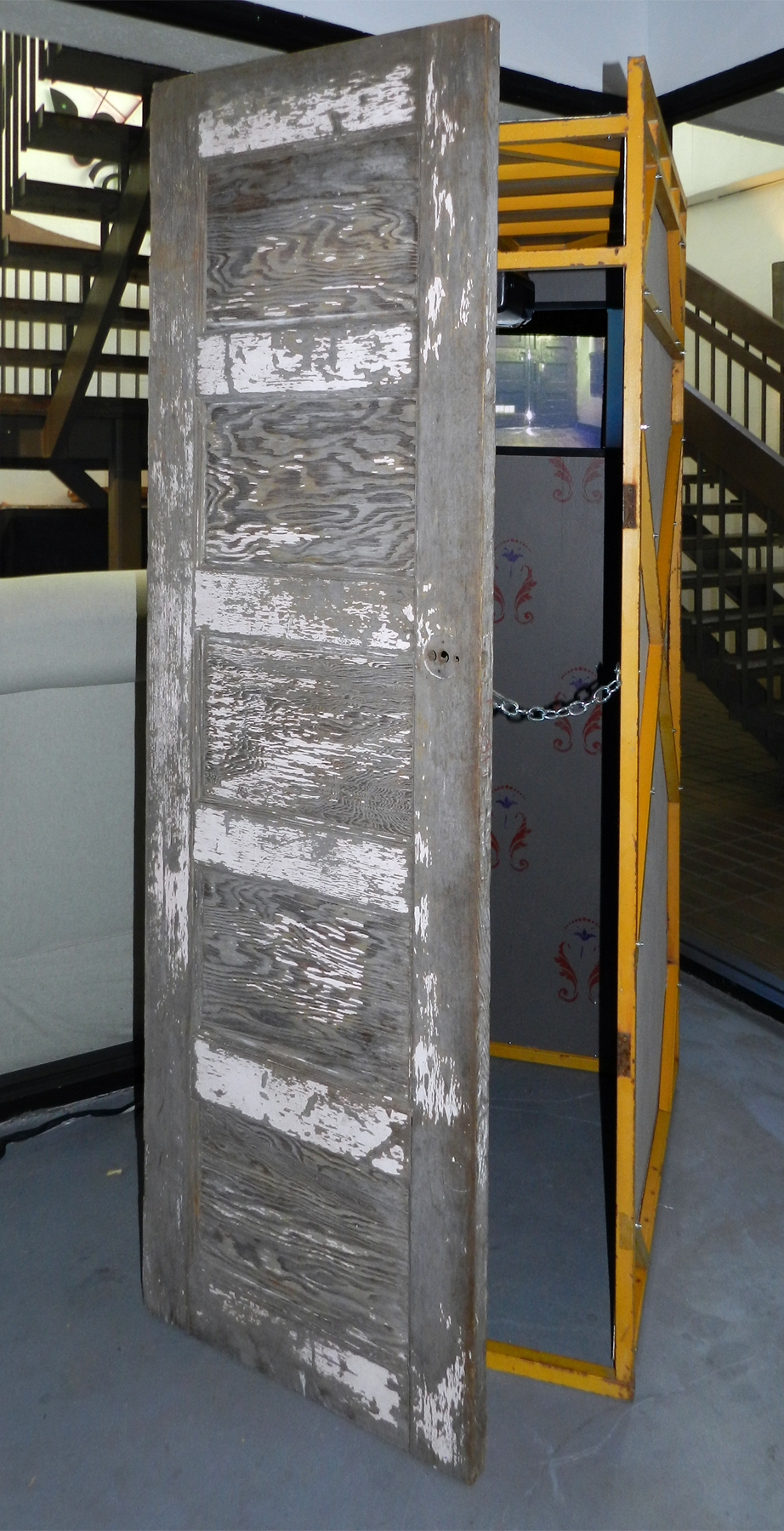
"Paranoimal", photo by E. Sher.

Since it’s not possible to discuss all of the complex works in this show, I’ll mention a brief sampling. In “Paranoimal” (i.e. paranoia the new normal), Elizabeth Sher and Brooke Holve created a small closet-like room with an old wooden door held ajar by a short chain. Peeking inside, you view a video where a woman (Brigit Marie Henry) moves apprehensively down the hall of an old hotel looking into rooms. As she opens each door, she looks in only to find herself looking back at her/us. The video loop becomes a disconcerting sequence involving the viewer as we watch someone watching themself.

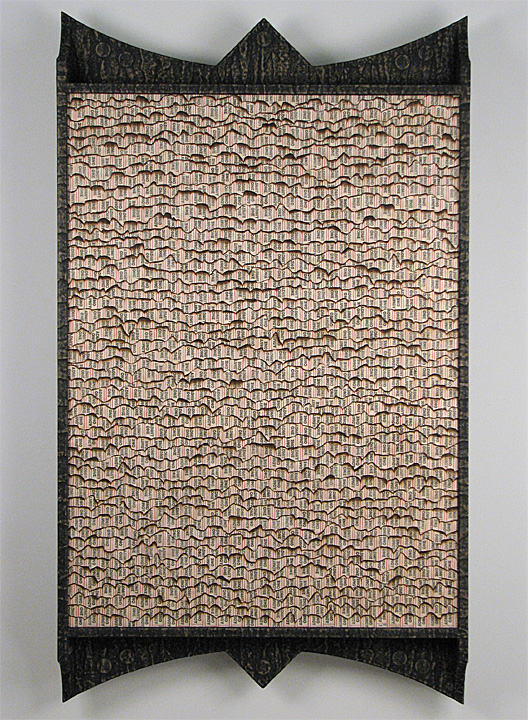
Nigel Poor’s “I Confess” was inspired by a new iPhone app. According to the artist, “Confession: A Roman Catholic app, thought to be the first to be approved by a church authority, walks Catholics through the sacrament and contains a ‘personalized examination of conscience for each user’.” Going with this bizarre concept, Poor sent out two hundred letters to acquaintances as well as strangers requesting them to anonymously share their confessions with her. The twenty-three responses she received were printed on small white plaques that were attached to the wall on narrow ledges. To continue the project she has included a supply of SASE, where you too can send in your confessions.

"Suitcase"

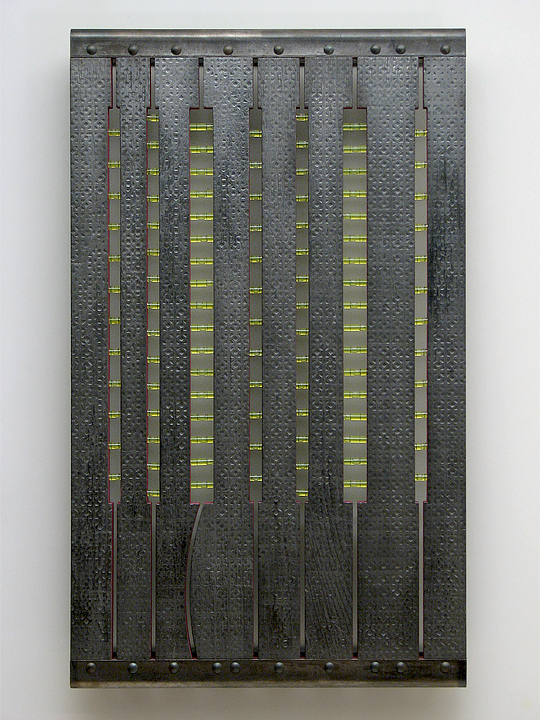
Does airport security make us safer or is it a personal invasion? Sherry Karver’s “Surveillance Series; Suitcases”, involves images that she photographed off of airport screening machines that show the contents of suitcases. These images were then inserted into the lids of actual suitcases and backlit from inside. The usual paraphernalia, shoes, umbrellas, and eyeglasses are there, but the images were “enhanced” with the addition of more ominous items, such as guns, bombs, scissors, and liquid filled bottles. With a dash of humor, the piece plays into our fears of what we imagine might be lurking in someone else’s bags.

Noting the often futile pursuit of personal information, Antonio Cortez and Rosa Maria Alfaro, created “But I Still Haven’t Found What I Am Looking For”, which consists of two video monitors mounted on two silver cylinder trash cans full of trash. One video shows changing images of trash in the cans, the other one streams texts of viewer comments that address the issue of searching our trash for incriminating evidence.

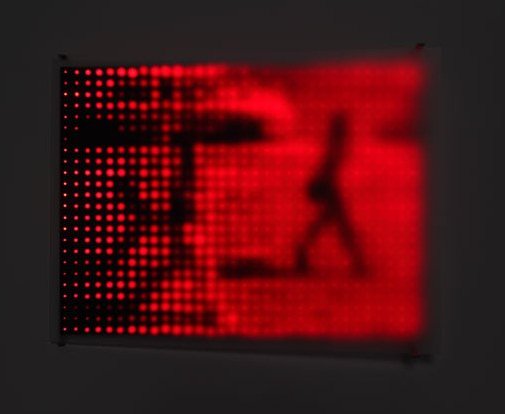
"Church on Fifth Avenue", image from Jim Campbell's website.

For me, one of the most successful pieces in the exhibition is Jim Campbell’s “Church on Fifth Avenue”, which is part of his Fifth Avenue Series 2001. Simple, yet complex, the piece uses custom-made electronics, and video footage taken in the days directly following 9/11. A grid of 768 pixels made out of red LEDs displays a pedestrian and auto traffic scene in NYC. A sheet of diffusing Plexiglas is attached to one side of the frame and angles away from the grid, causing the moving images to gradually go from a digital representation to an analog one. As a result I found myself attempting to visually grasp the fleeting images of the street scene as they moved across the glowing red screen before becoming too digitized to recognize.

The final one I want to mention is a fun, counter surveillance piece by Michael Zheng. The piece, “I See What You See”, is a video that was created covertly during the recent exhibition “Exposed: Voyeurism, Surveillance, and the Camera Since 1870” at SFMOMA. While it was not officially part of the Museum show, the intervention apparently caused much delightful confusion about who was watching whom and why.

In the words of Hanna Regev, “the exhibition seeks to underscore the need to balance our longing for security with our dedication to a free and open society.” Walking through the darkened gallery, which enhances the viewing of light-based media, you begin to wonder who may be watching you.

The exhibition also included performances, film screenings, and other events. The next performance, “Micromanagement”, presented by Sean Fletcher and Isabel Reichert promises to be “an evening of sixteen experimental performance artists with an overbearing interest in their audience”. Saturday, October 15, beginning promptly at 8:00pm, and it’s free.

Exhibiting Artists: Rosa Maria Alfaro, Michael Bartalos, Guillermo Bert, Lisa Blatt, Jim Campbell, Enrique Chagoya, Antonio Cortez, Allan deSouza, Rodney Ewing, Roni Feldman, Sean Fletcher, Angus Forbes, Farley Gwazda, Taraneh Hemami, Brooke Holve, Justin Hoover, Sherry Karver, Scott Kildall, Barbara Kossy, Tony Labat, Mark Leibowitz, Charlie Levin, Jennifer Locke, Kara Maria, Andrew Mezvinsky, Daniel Newman, Nigel Poor, Isabel Reichert, Tim Roseborough, Roberto Rovira, Elizabeth Sher, Michael Zheng

The exhibition continues through October 22, 2011 at Performance Art Institute, 575 Sutter St., San Francisco, 415-501-0575. For a list of events related to the exhibition see the PAI website.

To see more on how we view each other, be sure to catch Looking at You, Looking at Me, at di Rosa, in Napa. Curated by Robert Wuilfe, the exhibition considers the relationship between viewing and being viewed, and the ways we look at each other. Opens October 29 and runs to February 18, 2012.

Posted in Art Reviews | Tagged , | Leave a comment

Poodles, Rivers, and Gutskin

Slaughterhouse Space
There is a rare opportunity in Healdsburg to view a pair of stunning multimedia installations. Sensory Interventions features the work of two artists, Pat Lenz and Hugh Livingston. Each artist makes a provocative statement of their own using different media to address distinct issues.

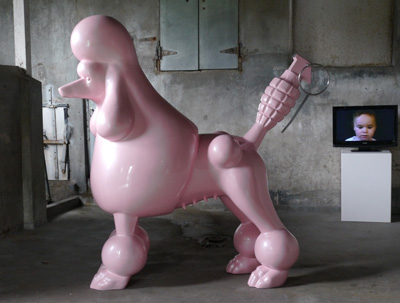
The exhibition space, which is a converted century-old slaughterhouse, makes a very unique backdrop for these installations. When I first entered the old industrial building I noticed the dark concrete walls reaching up to the high ceilings, and remnants of equipment still remaining from its former purpose. At the next turn I came upon a scene that left me amazed and speechless. There, in an alcove, amid somber grey walls, and rusty chains with hooks tucked in a corner, was a poodle. Not just any poodle, it was Nobody’s Poodle, a huge, opalescent pink poodle. Created by Healdsburg artist, Pat Lenz, the 7-feet tall by 8-feet long fiberglass and stainless steel sculpture makes an imposing visual impact and a tension of sensibilities in the space it holds.

Nobody’s Poodle is a potent feminist statement with a number of corollaries to Judy Chicago’s The Dinner Party, which is an expansive, triangular installation with ceramic place settings for 39 women from legend and history. The Dinner Party(1974-1979), brought to the foreground the forgotten and often undervalued achievements of women. While, at the time, considered art of a “special interest group”, The Dinner Party opened up greater possibilities for women artists to create art that is recognized as important on its own terms as well as in the broader art world. Lenz’ Poodle

Nobody's Poodle

Nobody's Poodle

departs from the realm of legend and history and creates a modern-day heroine, a new goddess who “embraces her femininity while exuding power and control; a force for peace and non-violence whose weapon is perfume emitted from a grenade-shaped (tail) atomizer”.¹

In answering the question, “what does it mean to be nobody’s poodle?” Lenz asserts that “No one can name you, command you, or lead you around. You think and decide for yourself.” This statement can also be seen as a legacy of Judy Chicago, who, for a 1971 exhibition, boldly posted on the wall that “Judy Gerowitz hereby divests herself of all names imposed upon her through male social dominance and freely chooses her own name, Judy Chicago.”²

Other similarities exist in their choice of scale, if not over-all size, to heighten the force of their message, as well as the use of stereotypical emblems of the feminine—such as items for dinner and vanity tables—as statements of strength and power, not something to be easily dismissed. Social commentary aside, there is also the attention to fine crafting that must be noted, whether in ceramic or fiberglass each artist produced visually spectacular pieces with exquisite surface finishes—Chicago’s China-paint glazes and Lenz’s pink automotive paint. Fabricated over time, each artist also worked with teams of collaborators to bring their projects to completion.

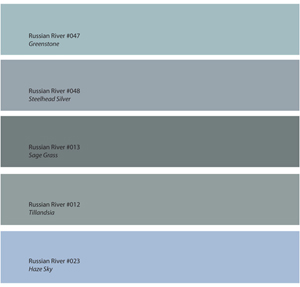
After leaving the Poodle and its ancillary multi-media pieces, work your way to the back of the building to discover Catch & Release, by Hugh Livingston. Employing video and audio installations, Livingston recreates the essence of the Russian River as he experienced it during his term as a Russian Riverkeeper Artist-in-Residence. In one segment, Livingston lines up a row of small video monitors. Each shows a video loop of a particular aspect of the river. Alongside each monitor is a color strip showing

Russian River Colors

a selection of hues seen in the video loop. The colors were technically extracted from the video and reproduced as accurately as possible onto the color strip. What occurs, because both can be seen in your frame of vision at the same time, is that elements in the video that match in color to the strip begin to pop out in a way that would not have been noticed otherwise, causing a shift of focus. The artist explains that “The River colors refract and pixelate and moirize. The collection here distills a few experiences to their essence, removed from the River and recontextualized.” Another piece can be viewed in a small dark room up a narrow flight of concrete steps. A streaming video is projected on the black wall. It takes a while to take it in and sort it out—words flow from top to bottom as a river, forking and re-converging with the main stream. I crane my head from side to side trying to read the flowing words without success. When I mention this to the artist he says that’s okay, they’re words from an Environmental Impact Report, nobody reads them anyway.

Slaughterhouse Space, 280 Chiquita Road, Healdsburg, CA 95448, 707-431-1514. Gallery hours are by appointment. www.slaughterhousespace.com. The exhibitions continue through September 10, 2011.

If you aren’t able to catch the Poodle in its Healdsburg location, you still have a chance to see it in Santa Rosa, where a second version is on display at Sonoma County Museum, and while the setting is not quite as dramatic, its sheer scale still strikes an inimitable presence.

Sonoma County Museum
Along with Nobody’s Poodle, the museum is showing Gertrud Parker: An artist and Collector. Trained as a fiber artist, and having been in close association with the Pacific Basin School of Textiles in Berkeley and with noted fiber artists such as Pat Hickman, Lillian Elliott, and Kay Sekimachi, Gertrud Parker founded the San Francisco Craft and Folk Art Museum in the 1980s.

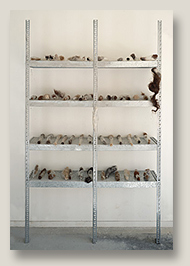
This retrospective exhibition primarily focuses on Parker’s use of gutskin as a sculptural material. Considered a natural fiber, gutskin has appeared as a popular medium in fiber art shows in recent years. The twenty, or so, pieces by Parker are accompanied by selected work by other artists from Gertrud and her husband’s, Harold Parker, private art collection. One of the most striking pieces by Parker is The Shelf. Composed of institutional-looking metal shelving which holds bundles of

The Shelf

human hair wrapped in gutskin, it is a peculiar, intriguing, and perhaps disturbing, piece that puts to question the psychological implications of hair, especially when it is no longer attached to the body.

The work by other artists from the Parker collection reflect and complement aspects of Gertrud’s work, enhancing the exhibition as a whole. Included are pieces by noted West Coast artists such as Gordon Onslow Ford, Mark Toby, Bruce Conner, and the Surrealist painter and writer, Leonora Carrington, who recently passed away, as well as others that often aren’t seen outside of private collections.

Sculpture Garden
After pondering all that pithy art, go outside to relax in the museum’s new Sculpture Garden; currently featuring work by Carroll Barnes, Roger Berry, Edwin Hamilton, Bruce Johnson, Ned Kahn, Pat Lenz, Hugh Livingston, amid landscaped berms, benches, and a small plaza.

Sonoma County Museum, 425 7th Street, Santa Rosa, CA 95401, (707) 579 1500, Museum Hours, Tuesday – Sunday 11am – 5pm. www.sonomacountymuseum.org. The exhibitions continue through September 11, 2011.

_____________________

¹Press release, SlaughterhouseSpace, May 25, 2011.

²Women Artists in the 20th and 21st Century. Ed. Uta Grosenick (Cologne: Taschen. 2001). P. 78.

Photographs from SlaughterhouseSpace, and Sonoma County Museum websites.
Posted in Art Reviews | Tagged , , , , , , , | Comments Off on Poodles, Rivers, and Gutskin

A Summer of Book Arts

With major museum exhibitions and a two-month long Celebrate Book Arts event in Sebastopol, the art of the book features big this summer in Sonoma County.

Sonoma Valley Museum of Art opened two related exhibitions on June 4. Six Fairy Tales from the Brothers Grimm, Original Etchings by David Hockney consists of 39 prints illustrating six tales from the collection of the famous brothers, and is presented in the front section of the museum.

I was surprised to learn that David Hockney has an extensive background in printmaking. There’s a lot more to his work than L.A. swimming pools and photographic collages. The exhibition is laid out like chapters in a book, with five or six prints, primarily etchings and aquatints, from each story, set in their own alcove. Printed booklets available in each section provide background information about the stories and Hockney’s process.

Created in the late 1960s, the prints show Hockney’s marvelous and subtle wit as he puts his own spin on the stories by combining contemporary imagery with traditional plots—Rumpelstiltskin’s straw is miraculously “woven” into a solid brick of gleaming “Gold”. His knowledge of the old masters is nestled into the compositions here and there with riffs from classic Madonna and Child poses to Uccello’s stout horse and rider, knotted tail and all.

Hockney’s story illustrations are accompanied by a second exhibition at the back of the museum, enhancing and further expanding the theme of books. Rebound; A Survey of Contemporary California Artists’ Books, curated by Simon Blattner, offers a fine sampling of handcrafted books. Featuring a variety of approaches to bookmaking styles, examples include accordion, loose-leaf broadsides, as well as more traditional bindings. Represented in the collection are works by such notables as Enrique Chagoya, William Wiley, and Squeak Carnwath, as well as excellent examples by rising stars, like Bettina Pauly’s intricately cut out and detailed carousel books.

At Sebastopol Center for the Arts, three exhibitions offer different yet unifying perspectives to the art of the book. On the entrance lobby wall, Art of the Picture Book; Behind the Covers highlights the development of illustrated children’s books from idea to finished product. Each of four artists/authors, Christine Walker, Teri Sloat, Stacey Schuett, and Gianna Marino, shows the evolution of ideas from initial concepts and sketches to mock ups and, finally to published books.

In Gallery II, From the Endpapers, Katherine Klein explores ideas and images about the passage of time in a specific place she knows well. With maps, drawings, paintings, and installations, Klein creates a portrait of a small valley in the Missouri Ozarks, where she often walked as a child. The map’s legend guides us to the details of the trees, stones, and ripples on the water. In addition, oil paintings on birch panels, inspired by the medieval “Book of Hours”, portray the changing of seasons in the landscape along with appropriate human occupations.

The Main Gallery features Bibliophoria II. This national juried exhibition includes over 50 handmade books chosen by artist and teacher, Sas Colby. In her selection process Colby stated, “I looked for well-crafted work that demonstrated a unity in its content and form, such as the metaphorical use of materials, or the non-traditional shape of a book.” When the concept of books gets into the hands of artists, anything can happen. On view here is a marvelous variety of traditional and untraditional materials, techniques, book forms, and binding methods, as well as deconstructed and altered books.

While there are many outstanding examples, some stand-outs for me were The Wild Book, by Bettina Pauly, an accordion-type book of four pages with cut outs allowing you to see from the first page to the last, with each layer of images creating another part of the story. In Come Undone, Lisa Naas splendidly integrates the content of the book with its construction and materials. The black corset-shaped book opens by undoing the ribbons to expose soft leather pages. Some have embroidered words which look like tattoos, while other pages reveal clandestine photos. Finally, I have to love a book that comes in a petri dish. Diane Stemper’s Darwin’s Darling Finch(s), with its clever illustrations on round pages, fits snugly in the glass dish.

In general books can be more fully appreciated when picked up and “read”, so it’s a real treat that touching (hand cleaning wipes provided) is allowed for most books in the exhibition.

Sonoma Valley Museum of Art, 551 Broadway, Sonoma, CA 95476, 707-939-7862, exhibitions run through August 28.
Sebastopol Center for the Arts, 6780 Depot St., Sebastopol, CA, 95472, 707-829-4797, exhibitions run through July 23.

The celebration of books continues with Bibliophoria: Celebrate Book Arts, a multi-venue series of events in Sebastopol. For more information go to bibliophoria.com.

Boy in Fish

The Boy Hidden in a Fish. By David Hockney

The Wild Book, by Bettina Pauly

Left photo by David Hockney, from www.svma.org.
Right photo by Satri Pencak.
Posted in Art Reviews | Tagged | Leave a comment

Figments for a Warrior; work by Catherine J. Richardson

There is a place where distant memories merge with dreams and legends. Catherine Richardson’s imagery seems to arise from this place. In Figments for a Warrior, currently at the Hammerfriar Gallery, her paintings on canvas and wood panel explore real and imagined archeological sites and ship burials. There is a sense of time-travel suggesting the flow of civilization’s unending continuity. Hints and clues of where and when are found among the layers blurred in time and history. Along with thirteen paintings, two small objects, cast in resin and placed on pedestals, offer tangible evidence of found treasures.

For Richardson, this ancestral history is in her bones. In the paintings imagination merges with remembrances of her many visits ancient burials, including the Sutton Hoo site near the East coast of England. The British-born artist states; “As a child I would bury dead birds and mice, mark the grave and dig them up later to examine the remains. During my many visits to the British Museum what continually captivates my curiosity is death and decay and the ritual preparations for an afterlife evident in ancient burials. When graves are excavated what is released? How does this deep history of place inform us?” The work in this exhibition probes deeper into these mysteries, making inquiries without conclusions.

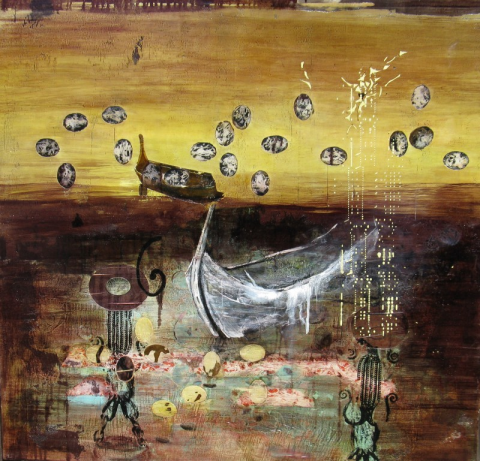
Richardson’s choice of media, color and process enhances the feel of an excavation. In Ship Burial, brown-black pigment is applied, scraped and scored, revealing layers of history, bits of bright colors from another time. A white spirit ship lies partially buried in the sand, its graceful translucent planks still holding the fading memories of sea-faring warriors. The space is ambiguous, perhaps beneath the sea, perhaps on the shore with the golden dusky sea stretching beyond to a vague horizon. Egg-shaped forms toss about above the ship or rest below, still buried with what they know inside. Other objects, no longer quite recognizable, emerge from the sand released from their long burial. We can make up our own stories of their purpose and history.

The paintings present a multiplicity of space—the ambiguous division between land, sea and sky—calling to mind the surrealist paintings of Yves Tanguy. His otherworldly landscapes, with a dense unbreathable atmosphere, are populated with odd biomorphic objects. Though for Richardson, the objects are less abstract and the compositions grounded in a more familiar time, space and history.

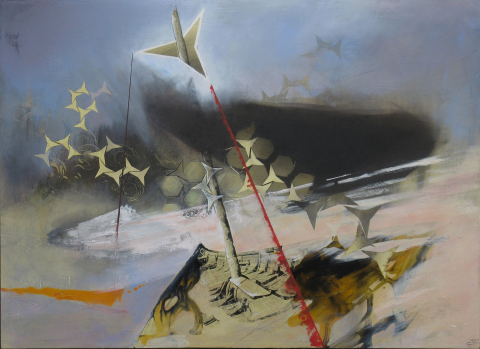
In Close To the Wind, the prow of a ship plies forth, leaning to port into the unknown misty blue, in the near distance the looming dark gray shape of another ship threatens. The use of what appears to be a photo-transfer process for the ship in the foreground adds perspective and nice touch of nautical detail. The ship’s mast darts diagonally upward, piercing a three-point star. The two are joined by a striking bold red line, which becomes a stay for the mast, holding it and the composition taut. A flurry of additional pale gold three-point stars creates effervescent spirals twirling off and fading into the distance like strange sea birds.

Recurring motifs and colors weave through the body of work; the red line, the three-point stars, and of course the ship as well as other objects, give a sense of continuity, if not familiarity, as one travels through the exhibition, searching for something lost, something remembered.

The exhibition continues through July 2, 2011 at Hammerfriar Gallery, 139 Healdsburg Ave., Healdsburg, CA 95448. 707-473-9600. http://www.hammerfriar.com

Ship Burial

Ship Burial

Close to the Wind

Close to the Wind

Photos from www.cjrichardsonstudios.com
Posted in Art Reviews | Tagged , , | Leave a comment

Premonitions: New Paintings by Adam Wolpert

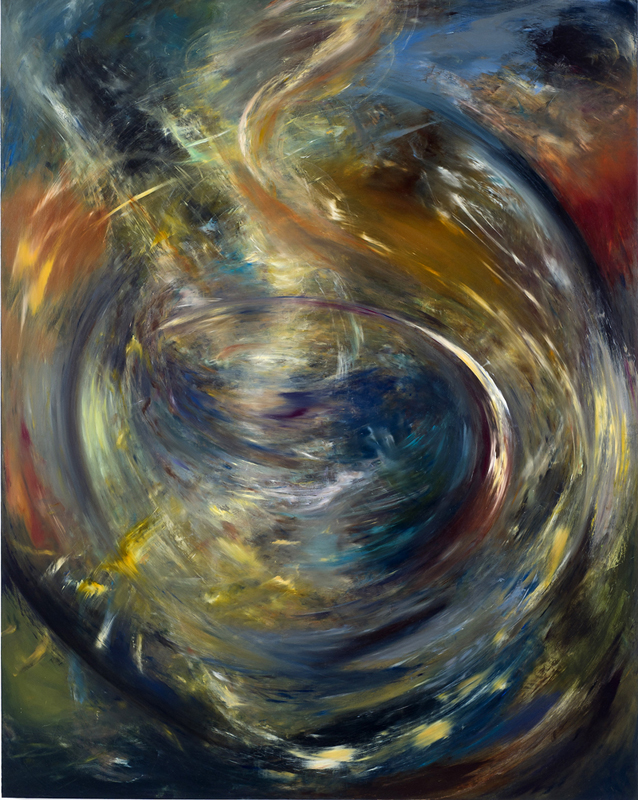
Human scale is an important aspect of Premonitions: New Paintings by Adam Wolpert at Quicksilver Mine Co. in Forestville. While the abstract imagery feels vast, at 5-foot by 4-foot the eight large canvases in the gallery are approachable in size. One can easily step into and engage with them visually. Four smaller, oil on paper works allow you to catch your breath with a more bite-size scale.

The body of work as a whole evokes dynamic energy fields. Strong and powerful, the opposing forces seem to keep seeking balance. What may appear as a wave of destruction, circles back as the surging life force of creation. The compositions also hover between abstract and representational. Are they macro views of the universe, perhaps the swirling cosmic gases of a distant nebula, or deep inner micro space of the life force in action on a cellular level?

They can also be seen as abstract conveyances of fleeting premonitions, as the exhibition title suggests. While visiting the artist in his studio, surrounded by meadow and forest, we discussed the meaning of premonitions. What came up then was that, more than just a “knowing before”, it is the tapping into the energy field of information—that which exists but has not yet been made manifest.

For Wolpert this is daily food for thought, in his life-work and in his artwork. As a co-founder of Occidental Arts and Ecology Center, where he lives and teaches, his primary concerns have to do with art, community and the land. As a result, his oeuvre tends to be imbued with deep ecology, which emphasizes the interdependent nature of all life, human and non-human, as well as the importance of the ecosystem and natural processes. Everything is connected to everything else.

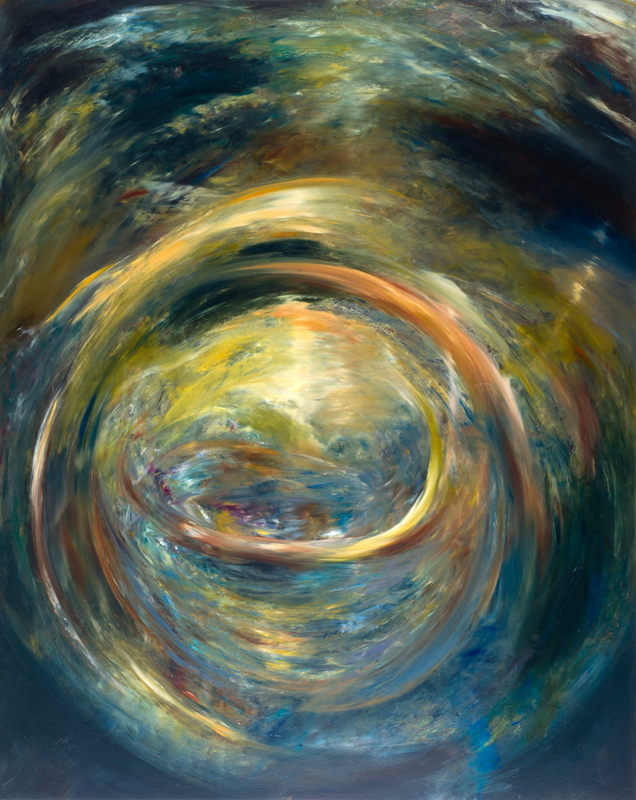
This current body of work can stand very well on its own, and yet reflects a continuing evolution from his previous work. We can see where Wolpert has gleaned the abstract visual elements from his nature and landscape paintings—wind-stirred grasses, bits of blue sky revealed through branches, or the glint of sunlight from behind a cloud—and transformed them. In particular, these “premonitions” can be seen emerging from his Silent Circles, gold fish series, (2000). For example, in Premonition #1, Cradle of Light, the swimming fish have spun themselves into flying flecks of gold, brown, yellow and blue, creating a vortex that draws you into its depths and into another dimension.

The work is vested with a turbulent, but not chaotic, transformative energy, yielding an almost visceral response—the energetic surge of landscape formation. A rich surface quality is created with the oil colors on linen, and in close examination of the details can be seen the complex layering of hues, creating a dynamic woven tension.

The exhibition continues through May 22. Quicksilver Mine Co. is located at 6671 Front St., Forestville. Gallery hours are Thursday through Monday, 11 a.m. to 6 p.m. For more information, call (707) 887-0799, or visit the Gallery website at www.quicksilvermineco.com.

AW01

Premonition #1 - Cradle of Light

AW012

Premonition #12 - Event Horizon


Images from www.adamwolpert.com.
Posted in Art Reviews | Tagged , | Leave a comment

In Material: Conversations on Qualities of Materiality

From the work of three artists emerges a conversation about shared experiences expressed in different styles, media, and techniques. In Material, currently on exhibition at Quicksilver, features the work of Brooke Holve, Susan Field, and Elizabeth Sher. Each of the three artists participated as artists-in-residence at New Pacific Studio in Mt. Bruce, New Zealand, however, not at the same time. They discovered each other back in California, and began a dialogue about how materials and process informed and guided their aesthetic choices which evolved into a shared creative endeavor. The culminating body of work is distinctive and yet self-reflective, showing unique and individual styles but also their connections, synchronicities, and eventual creation of new work based on their meetings, musings and conversations.

While employing such diverse materials as rock, fabric, video, photography, and algae, the work is an investigation of the forms and forces of nature. Notions of solid, fluid, and tactile speak of wind in the grasses, reflections of passing clouds, processes of growth, decay and transformation.

Sher’s photography and video suggest representational images and implied narratives. Printed on canvas, metal or paper, hovering on the edge of abstract, her work traces movements and patterns of wind, water, and organic changes. In Storm, Sher printed still images from video footage of grasses blowing in the wind. The 16 metal panels are attached to the wall on pivoting supports and arranged slightly askew to enhance the feeling of movement and disruption.

In her constructions Holve often combines book remnants with organza silk, paper prints and other materials as she explores what happens through their interactions. Patterns and textures of nature are abstracted and layered with printed paper images that peek through scrims of screen-printed organza. In a pair of lovely pieces, titled 1111 and 2222, Holve created abstract patterns using book board and cloth, which she partially veiled with sheets of dried and printed river algae.

Field pairs odd objects and materials, mixing textures and contexts that seem to grow or morph into new objects and contexts. Her Stones with lichen-like patches of beadwork and thread are soothing and beg to be caressed. On the other hand her Untitled Installation, constructed of toy railroad track, zippers, metal snaps, and 35mm film strips, looks like a marvelous spiky growth that creeps up the wall and across the ceiling, reminiscent of Aljoscha’s biomorphisms that have been appearing in various European locations.

“Last summer, we visited Liz’s home by the Russian River and spontaneously decided to go down to the water to film,” the artists recalled. “Ducks were swimming through algae that floated on the surface of the water, we filmed and then harvested some of it to dry.” The dry sheets of algae were subsequently sewn, printed on, and incorporated into work that is part of the exhibition including a video installation.

In tangent points of connections and departures, In Material presents a cohesive array of materials, textures, and processes reflecting on ideas, memories, and artistic emotional engagement.

Join Susan Field, Brooke Holve and Elizabeth Sher for a Gallery Talk and Conversation on Thursday, April 7, beginning at 7pm. The exhibition continues through April 10.

The Quicksilver Mine Co. is located at 6671 Front St., Forestville. Gallery hours are Thursday through Monday, 11a.m. to 6 p.m. For more information, call (707) 887-0799, or visit the Gallery website at www.quicksilvermineco.com.

In Material

In Material installation at Quicksilver.

Photo by Frank Field, www.edgelightimages.com
Posted in Art Reviews | Tagged | 1 Comment