Adela Akers @ Quicksilver Mine Co.

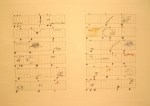
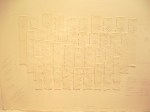
Currently on view at Quicksilver Mine Co., in downtown Forestville, is Adela Akers, Threads of Illusion. The exhibition features large and small-scale hand-woven tapestries created over the past ten years, including work completed just this year. Adela’s beautifully crafted weavings are composed of abstract geometric patterns, inspired by pre-Columbian, African, and other textile-based cultures, as well as architecture and more contemporary abstract art modes. The repetitive geometric structures suggest language, coded messages, and forms of record keeping. For Adela, whose work is strongly influenced by her science background, the mathematical principles contrast well with the organic process of discovery, allowing for her inner visions to unfold.

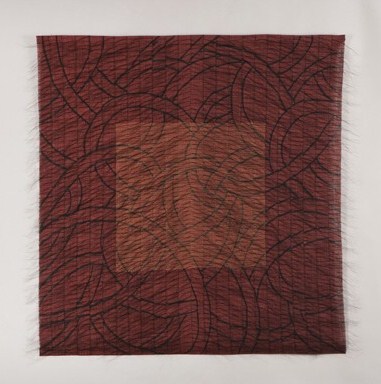
Circles in the Square, 2010

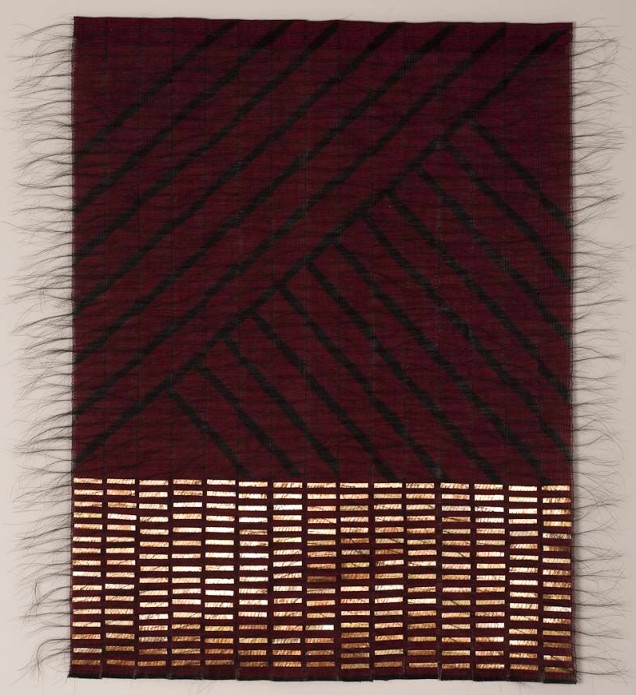
Akers considers herself an artist first, who happens to use fibers and weaving as her medium. This assertion is well supported by the complexity of her materials and process, which results in rich and detailed weavings. She begins with finely woven linen strips that are sewn together. Then additional materials are applied or incorporated. For example she weaves in horse hair, which historically has been used for upholstery fabric, but here adds elements of fine lines that soften the more hard-edge forms. She also applies paints and inks directly to the warp threads, or even to the finished woven cloth. Finally she adds thin bands of metal, which are recycled from the foil seals of wine bottles. These she cuts into narrow strips, then stitches onto the woven linen segments.

End Section, 2012

Adela currently lives and works in West Sonoma County, but her long distinguished career has taken many curves and turns. Born in Spain in the 1930s, and trained in science, she began her career as a biochemist in Cuba. She eventually moved to the United States, and studied at the Art Institute of Chicago, and the Cranbrook Academy of Art in Michigan. Later she taught textile arts at the university level on both coasts until her retirement. Akers has exhibited her work extensively, including solo shows in New York, San Francisco, Philadelphia, and Los Angeles. Her work can be found in the collections of the Smithsonian Institution, the Metropolitan Museum of Art, the Museum of Art and Design, as well as the Sonoma County Museum, and many private collections around the country.

You can also see a well-done video interview of Adela on the KQED Spark program. The video shows her working at her loom while she talks about her materials and process. The exhibition continues through September 23. For more information check the website, www.quicksilvermineco.com

Photos from Quicksilver Mine Co. website.
Posted in Art Reviews | Tagged , , | Leave a comment

Best Bets, 7.9.12

Here are my Best Bets in the visual arts for this week.

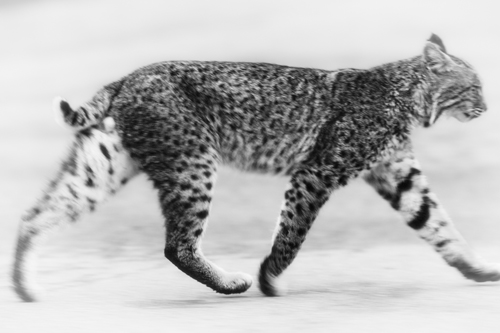
Bob Cat

“Bob Cat” by Trish Carney

Currently at di Rosa in Napa, is Entering the Wild, an exhibition that features over thirty pieces by six Northern California artists. Some years back Barry Lopez wrote an essay called The Near Woods, in which he described “the elusive and magical space between the wild, deep woods and the civilized space of humans”. This premise is the binding thread for the theme of this exhibition, and a special edition of the book, designed by Charles Hobson, is on view. Many of the other works in the show reflect on this margin between the animal and human world, bringing up questions such as; “How are we like them, and what can we learn from the mystery and wonder of their behavior?” In a large-scale wall installation called Up From Under the Edge, artist Adriane Colburn, uses various materials to investigate the complex relationship between human infrastructure and the natural world. She includes a viewing tube that’s set at about knee level, and if you make the effort to look in, you’ll see video footage of bugs and microbes that live beneath the soil.

In Animals Around Me, Lukas Felzmann uses photography to capture images of animals we may encounter, including wild, domestic, and dead ones, as well as those destined to be a food source. The piece as a whole is quite thought provoking. One of my favorite pieces, by Jane Rosen, White Scarf Skyscraper, is a hawk made of cast glass that is perched on a marble pedestal. To me it stands as a monument to the birds of prey that inhabit and nest in urban areas. The exhibition continues through September 23. For information check their website, www.dirosaart.org.

Then, at Sonoma Valley Museum, on Broadway, we have Cross Pollination; the Art of Lawrence Ferlinghetti. The title, Cross Pollination, is quite apt for this exhibition as it pulls together a number of influences and thematic parallels that have been consistent throughout his career. Most of us know Ferlinghetti as the beat era poet and co-founder of City Lights Bookstore in San Francisco, and both of these are true. However, Ferlinghetti, who is 93, has also devoted much of his career to the visual arts, and the show includes a very recent set of lithographs that he created to illustrate is latest poem book, Out of Chaos.

out of chaos

Out of Chaos

The paintings, prints, and drawings in the exhibition are a sampling of his work, which touch on the themes of politics, his relationship to women, and his time spent at sea. Through the work he also engages in direct dialogue with other artists and writers. The exhibition curator, Diane Roby, states that “In Ferlinghetti’s art, words give rise to image-making, and word and image meld in the paint.” A powerful painting, titled Moloch, sums it up. On the large canvas, iconic elements from The Scream, by Edvard Munch are painted in white on a black background, lines from Allen Ginsberg’s poem, Howl, are written across the top, and as the gallery label states, this is where “Howl meets the Scream”. The exhibition continues through September 23, for more information check their website, www.svma.org.

Posted in Art Reviews | Tagged , , , , , , , , | Leave a comment

Chester Arnold: Trees @ Sonoma County Museum

Through his paintings Chester Arnold brings us face to face with the harsh realities of “life in the country”; meaning we want the beauty of the forests, but we also want lumber for building, wood for burning. To help us ponder this dilemma Arnold also brings into his work an equal measure of hope and humor.

Having been tutored in Germany as a youth, Arnold has a keen awareness of traditional nineteenth-century European landscape painting. This influence can be noticed in the composition and development of the natural elements in his work, such as trees, sky, and seasonal conditions. Arnold was particularly influenced by the German romanticist, Caspar David Friedrich, whose pastoral landscape paintings are tributes to the spiritual mystery of nature’s vastness, where humans come and go, leaving their marks, but eventually nature prevails. Upon this backdrop Arnold overlays contemporary social-political issues such as environmental degradation, overconsumption and the mishandling of consumer waste. While many of Arnold’s paintings are based on natural landscapes and the impact of civilization upon it, the work in this particular exhibition focuses more specifically on trees and forests, bringing to our attention the very current issues of logging and land use, but we also see elements of natural decay, and the power of nature to keep things in balance.

Turning

“Turning”

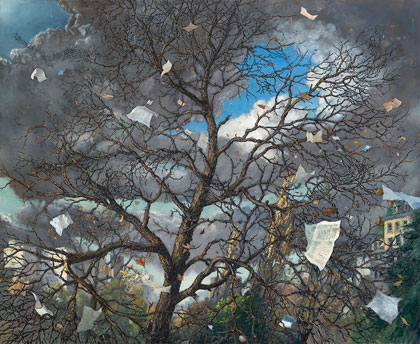
In the 2009 painting, Turning, we see a copse of leafless trees in the foreground, marking the margin between nature and civilization. Brooding dark skies hover over an urban skyline in the background, forewarning the coming storm. A lovely, moody scene—if it weren’t for all the bits of litter and refuse strewn through the trees, clinging to bare branches. To the right of the forest is a cluster of city dwellings, set precariously askew, their windows appear as eyes staring with helpless concern, is their tidy domain being encroached upon? In the left corner a murmuration of starlings’ swirls in the sky, hinting at the presence of wildness, perhaps nature will prevail and take back its territory.

Crooked Timber

Crooked Timber

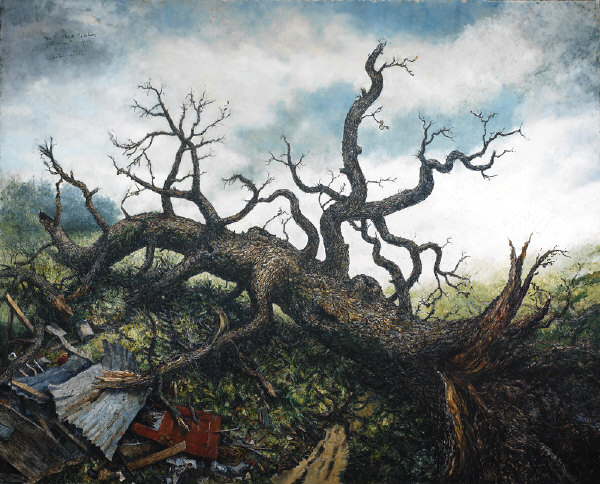
The allegory of man and nature appears in various ways throughout the work. In The Crooked Timber, 2010, the subject is a fallen tree; the twisted form of the once proud oak reclines on its side, the timber is crooked, not suitable as building material, but will make a good home for mice and beetles. The painting is accompanied by small sketches using washes of oak gall ink, lending a sense of lasting reverence to the great fallen tree.

Perpetual Care

Perpetual Care

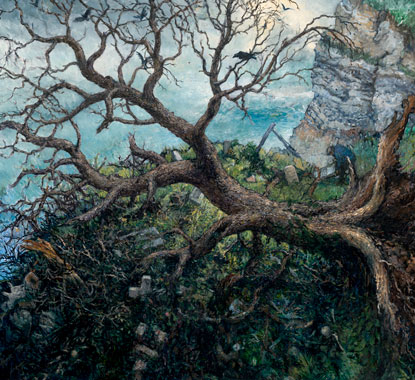
Cemeteries offer compelling parallels to life, death, and rebirth in nature. Arnold’s painting Perpetual Care, shows tombstones of a neglected cemetery being consumed by nature for perpetuity of a different type. The scene takes place at the world’s edge, beyond is the great unknown, a small lone human tries to tend the memories, the crooked timber appears again, offering a perch to the raven who watches over knowing how the plot will unfold. In a similar manner the 1826 painting, Graveyard Under Snow, by Caspar David Friedrich, offers a similar message—humans are born, they die, nature takes over, all as it should be.

In a masterfully executed painting, Left Behind, 2010, we see a beautiful winter landscape, the edge of a forest along a snow-banked stream. Then, at closer look we notice the junk in the stream, detritus from human accumulation, which is slowly merging back into nature. In the distance, a man sits with his back to us at a campfire, deep in his own thoughts, which seem to drift away with the wafting smoke. Deftly painted brushstrokes intricately describe details of the twigs, pebbles, snow drifts, and smoke. The qualities of this wintery scene remind me of seventeenth-century Dutch paintings, such as Winter Landscape Near a Village, by Hendrick Avercamp, where the wintery village scene is populated with tiny figures going about their usual day-to-day routines, all in marvelous detail.

While living in Sonoma County, and teaching at College of Marin, Chester Arnold’s work has been shown and collected internationally and throughout the country. The paintings here present both a meditation and commentary on matters related to our precious native forests and woodlands.

Also at the museum is Hugh Livingston, Sonoma Oaks: Points of View. Livingston is a composer and multi-media artist, and for this exhibition he presents a series of audio and video installations on the patterns and sounds of California oak habitats. Livingston documents the environment with time-lapse and aerial photography, and he examines the sounds of raindrops and wind on oak leaves, then displays a “periodic table” of the sounds of Sonoma. This project is a continuation of his deconstruction of the Sonoma landscape, which began during his recent term in the Russian Riverkeeper Artist-in-Residence program. At that time Livingston recreated the essence of the Russian River as he had experienced it, and presented a multi-media color analysis of the Russian River. By dissecting and emphasizing selected elements, Livingston brings to our sensory awareness details we may otherwise have overlooked. Hugh Livingston’s work can also be found in the Museums outdoor sculpture garden.

A Curator’s tour of the exhibition is scheduled for Friday, July 6, 7 p.m. You can register on their website, space is limited.

The exhibitions continue through September 9, 2012. The Sonoma County Museum is located on Seventh Street in Santa Rosa. For more information check their website, www.sonomacountymuseum.org.

Images from www.sonomacountymuseum.org.


Posted in Art Reviews | Tagged , , , | 6 Comments

Best Bets 5.10.12

I am now recording audio spots for Best Bets on the Sonoma Arts website. You can go to their site and click the Best Bets button to hear the most recent posting, or you can read the text here on my website.

This week I recommend a visit to the Gatehouse Gallery at di Rosa, in Napa county. This time of year it’s a beautiful drive through vineyards, and green rolling hills. Once there you’ll see Cycle: New Work by Hung Liu, the current exhibition in the spacious lake-side gallery.

Hung Liu was born in China and immigrated to California in 1984, where she continued her studies in art. Liu’s work has been shown and collected by numerous top-notch museums in this country. She currently lives in the East Bay and teaches at Mills College.

The work in this exhibition features large, mixed-media paintings, which are derived from historical Chinese photographs. Starting with the photographic images, that are both her cultural and personal narratives, Liu reworks the surfaces with layers of various materials. In this process she conceals, changes, as well as reveals selected aspects of the original image. The story becomes a new narrative, combining both her future as well as her past.

The exhibition continues through June 10. While you are there, you may want to consider a tour of the sculpture gardens. The Gatehouse Gallery hours are Wednesday through Saturday, 10 a.m. to 4 p.m. For more information on events and tours, visit their website, dirosaart.org.

Then, at Art Works Downtown, in San Rafael, we have, Surface Design, an exhibition of nearly 30 pieces, that, according to the curator, Virginia Breier, illustrates the importance of surface design to the final object. And, indeed, when I saw the exhibition, I was impressed by how well the surface treatments were integrated with the artworks.

Plus there was a wide variety of materials and methods, including traditional ones such as wood, clay, glass, metal and fabric. But also more unusual materials such as coffee filters, tree bark, woven paper, and one I had never seen before, which was dried orange peels that were stitched together into large geometric shapes.

A reception for the artists is on Friday, May 11, 5 to 8 p.m. coinciding with San Rafael’s second Friday artwalk.The exhibition continues through June 22. For more information, check their website, Art Works Downtown.org.

Posted in Art Reviews | Tagged , , | 2 Comments

Best Bets, 4.19.12

I am now recording audio spots for Best Bets on the Sonoma Arts website. You can go to their site and click the Best Bets button to hear the most recent posting, or you can read the text here on my website.

My Best Bets for the week of April 19 to April 25, 2012.

We’ll start in Marin county, where there are two exhibitions celebrating the art of the book.

At the Marin Museum of Contemporary Art, in Novato, we have the 3rd Annual Altered Book and Book Arts Show. The opening reception is on Saturday, April 21, 5 to 7 pm., with a talk by Donna Seager at 4 o’clock. This is a fundraiser for MarinMOCA and there will be a live auction at the close of the show on May 26, 5 to 7 p.m. So you will have a few weeks to view the art and make your bids. The museum is located at the Hamilton Air Field, in Novato, for more information and a list of related events check their website, marinmoca.org.

Then at the Seager Gray Gallery in Mill Valley, is Art of the Book, an exhibition of handmade and altered books. This gallery was previously the Donna Seager gallery in San Rafael, but has recently moved to their new location in Mill Valley, with a new partner, Suzanne Gray. The exhibition features over 30 artists who work with books as an art form, and provides an extensive overview of this genre. Here you’ll find beautiful handmade books, and ones made from unusual materials and in unexpected forms, as well as altered books, which are existing books that have been artfully restructured. I consider Donna Seager to be the queen of book arts, or certainly one of the most knowledgeable people I know on the subject. A reception for the artists is on Saturday, April 28, 6 to 8 p.m. and the exhibition continues through May 31. Check their website, seagergray.com.

I also want to mention a couple of shows in Sonoma County worth noting. The first is the BFA Exhibition at Sonoma State University, which features the work of 14 recent graduates from the Bachelor of Fine Arts program. It can be really interesting to see what emerging artists are producing. The opening reception is on Thursday, April 19, 4 to 6 p.m., the exhibition runs through May 12.

Then, in Petaluma is Inner Landscapes: Paintings by Al Longo at the Institute of Noetic Sciences. In these abstract paintings Al renders his intuitive response to landscapes and the natural world by using color and sinuous biomorphic forms. The works are not meant to be a representation or reflection of nature but rather the sense of its spirit and its energy. A reception for the artist is on Sunday, April 22, 3 to 5 pm. The exhibition runs through July 12, and is being shown at the Institute of Noetic Sciences, at their San Antonio Road site.

For information and directions see their website, noetic.org, then go to events.

Posted in Art Reviews | Tagged , , , | Leave a comment

Sonoma Arts Best Bets Audio Spot

I am now recording audio spots for Best Bets on the Sonoma Arts website. You can go to their site and click the Best Bets button to hear the most recent posting, or you can read the text here on my website.

My Best Bets for the week of April 5 to April 11, 2012.

Currently the leading exhibition at the Sonoma County Museum, in Santa Rosa, is the Tsars’ Cabinet. This well-timed exhibition is associated with local Russian history and is part of the celebrations of the 200th anniversary of Fort Ross, which was the first Russian settlement in California. The exquisite dinnerware and other decorative objects are integrated with wall texts, giving a brief but coherent history of the Romanov Dynasty.

One of the ancillary exhibitions is Recent Work by Inez Storer. There are a number of connections here that make this a very appropriate companion show. Inez, who lives in West Marin, is married to Andrew Romanov, grand-nephew of the last Russian Tsar. But also, in the eleven, mixed-media pieces, Inez blends her personal as well as general histories with Russian elements. For example, in a piece called Maps of the World, she incorporates copied details from a 19th century sketchbook she found in Moscow. Inez will give an artist’s talk at the museum on April 14. Both exhibitions run through May 27.

Then at the Sonoma Valley Museum of Art, in Sonoma, we have Color Theory: The Use of Color in Contemporary Art. The exhibition is guest curated by Katrina Traywick, and explores the use of color by nine contemporary artists from across the country. A variety of media are represented including video, photography, collage, site-specific painting, and installation. The exhibition continues through June 10 and includes a number of lectures and events. Check their website for more information.

Now, in Geyserville, you can find the work of Randy Colosky at the Perdita Production Gallery. You may not have heard of this gallery because it’s rather new. The seven pieces in this small venue are a sampling of work he had been commissioned to do by the Museum of Craft and Folk Art in San Francisco, where a show of his work closed recently. Colosky uses industrial and construction materials in conceptual and non standard ways. The show runs through May 27, and the gallery is located at 21025 Geyserville Ave. Gallery hours are Thursday through Sunday, 12 to 6 pm. The owners say they have a whole roster of shows they lined up, so it’s worth a trip to Geyserville.

Lastly I want to mention the new show at the Phantom IV Gallery in Windsor. Opening on April 5 and continuing through the 29, will be Bohemia Ranch Waterfalls, New paintings and lithographs by Ryan Douglas and Bill Wheeler. This is very timely since Bohemia Ranch in Occidental has recently been saved from developers to become one of Sonoma County’s newest private parks. A reception for the artists will be held on Saturday, April 14, 4:30 to 7:30 p.m. Phantom IV Gallery is located at 9077 Windsor Rd., in Windsor.

Posted in Art Reviews | Tagged , , | Comments Off on Sonoma Arts Best Bets Audio Spot

Chris Beards: One Another One

The title, One Another One, is actually quite apropos for this exhibition. In his statement, Chris Beards explains;

“One is special—singular, unique, worthy of attention. . .
Another splits the attention by half, yet reaffirms the singular nature of One.
If Another One is added to One the result is Another One.
New connections and relationships are discovered in this process.”

Standing in the gallery space with Beards’ recent, mostly wall-mounted constructions, it all makes sense. As a body of work, the ten pieces communicate in a language of visual abstraction. Patterns and the repetition of forms and texture are pleasingly punctuated by well-placed disruptions. However, upon closer observation some pieces possess a narrative element, with layers of meaning, and subtle humor. I think of poetry where the cadence of syllables is equal in value to the meaning of words.

Horizon Line
Horizon Line, 2011

Visual references to fiber and textiles stand out for me—in the surface treatment, textures, and construction methods. This is especially noted in Horizon Line, which is made of eight vertical slats of wood with an overall burned-in pattern. The slats are separated by rhythmically spaced bubble levels, acting very much like the weft threads woven through the warp of the slats. Slight variations in shapes and placement impart interest and surprise. Additionally, the inner areas of the slats are painted a muted red, balancing well against the charcoal wood and yellow levels.

Archive

Archive, 2010

Beards’ interest in repurposed manufactured objects shows up in much of his work and is especially evident in Archive. The piece hangs from the ceiling—an organic, nest-like shape made of woven zip-ties is suspended from altered and fabricated metal hardware. A bulging bulk of woven black zip-ties is encased in white ones, giving a metallic look of chain link fencing. The balance of soft and hard materials is coaxed together with a limited color palate of black, white, silver and a touch of coral-pink.

Hell
Hell, 2010

Other pieces in the exhibition express more narrative elements and nuanced commentary. For example, Hell is encased in a rectangular frame with flame or bat-wing-like shapes. This shape is repeated in row upon row of individually singed ADMIT ONE tickets, the layered rows create the feel of a tapestry. One wonders if the hell part was when the artist was scorching all those tickets.

Influence

Influence, 2012

Influence is a particularly thought-provoking piece. Constructed from wooden crib sides, the piece is presented as an abstract shape of shiny black horizontal and vertical lines, set off by one well-placed curvy member. All of the components are tightly wrapped in video tape featuring such hits as The Little Mermaid, A Clockwork Orange, Sleeping Beauty, The Matrix, and The Piano. However, the continuous black swaddling doesn’t reveal a single story line. A sprinkling of reflective dots, like fairy dust, completes the notion of hidden, though potent influences on children.

The work demonstrates Beard’s elegant awareness of materials and quality of construction, where everything is neatly held together, and each component is an integral part of the whole. While the pieces here focuse on Beards’ more flat, geometric work, he also applies many of these same qualities to three-dimensional biomorphic-mechanical forms with obscure purposes.

For Beards “Structure, context, and meaning are created and explored through experiments with organized patterns and repetition in a variety of media.” The body of work is coherently held together by the consistency and complexity of pattern and repetition, along with doses of lighthearted as well as poignant messages.

Chris Beards: One Another One continues through April 8, 2012, at Quicksilver Mine Co., Forestville, CA 95436; 707-887-0799; http://www.quicksilvermineco.com

All images from Chris Beards’ website.
Posted in Art Reviews | Tagged , | Comments Off on Chris Beards: One Another One

Art Notes From a Week in L.A.

I just recently returned from a week in Los Angeles, spending four of those days at the College Art Association Conference. With this being their 100th annual conference, and all the Pacific Standard Time events and exhibitions going on, it was a very exciting time to be in L.A.

The conference schedule was so jam packed full that one could only participate in a fraction of the offerings. I focused most of my time on professional development seminars and attending sessions that were presenting new and different ideas for me. I did hear some good art history talks, but with so much new media and concepts out there, I wanted to stretch my horizons a bit.

Here are some highlights:
Fundraising in a Box: Crowdsourcing Microgrants, presented by Fractured Atlas, the panel included representatives from Kickstarter and RocketHub. (There are other ones that weren’t represented here.) While I’ve been aware of Kickstarter for a couple of years it was very informative to learn details about how it works directly from people involved.

Aside from being another way to raise funds for a project, crowdfunding offers alternatives to current economic models. One could say it’s the part of the DIY economy, allowing people to take more control of raising their own funds, and making use of social media technologies. Instead of going through the usual hoops for grants from large corporate sources, creative projects can be realized by activating and motivating your personal network and beyond. Corporate and crowdfunding can also work together, large donors may be more likely to fund your project if they see you are seeking funds from a variety of sources.

Another advantage is that crowdfunding promotes a greater freedom for creative project development, as well as allowing for a broader support base—people participating because they are enthused about what you are doing, and want to be part of it.

Contemporary Collectives and Collaborations, brought together a panel representing five different art collectives to talk about how they operate and the type of projects they are involved with. Collaborations can be conducted in person as well as virtually, and indeed, a couple of the speakers were “present” via Skype.

The groups presenting were L.A. Art Girls, who have done performative projects together, and seek to provide inspiration, support and feedback to one another; Berlin Collective does not necessarily work on projects together but has created an international community that provides member support; The League of Imaginary Scientists (my favorite), gets scientists to work with artists and has been very inspiring on both sides of the table, one project mentioned was a dance that was choreographed to the patterns of a chemical reaction; @Platea is a global, online, public art collective that has taken on a virtual life of its own; and Finishing School, which is an interdisciplinary artist collective that explores contemporary social, political, and environmental issues.

Some of the issues discussed among the groups were how they dealt with authorship and collective identity, and that, for the most part, their projects are experience based, with few, if any, final objects aside from documentation.

Momentum: Women, Art and Technology, was a discussion by several panelists on women who embrace the use of technology as a primary mode of expression. One of the two that stood out the most for me was a presentation by Aileen June Wang about the work of Chinese artist, Cao-Fei. Cao’s recent project, RMB City, is a virtual reality interactive video game. As an online public platform for creativity, it provides a laboratory for experiments in art, design, architecture, literature, politics, economy, and culture. Launched in 2008, it continues to grow and change with participation from around the world.

The other one that impressed me was Digitized Archives by Lynn Hershman, which addressed the issue of how to archive performative art for the future and keep it relevant. Hershman worked with Stanford University, where her site-specific artwork, Dante Hotel (1974), is housed in 90 grey boxes containing the papers, photos, films, recordings, etc. from the original nine-month project. The goal of the Stanford project, called Life Squared, was to animate the existing archive, converting it into a digital format of hybrid genre, which included digitized archival documentation and “virtual” installations in a new work called Second Life. This virtual site encourages people to revisit and interact with the past, thus re-configuring the old work into a new form and new context, as well as expanding the audience and accessibility for this material.

Finally, on Friday I attended a session called Women, Surrealism, California, and Beyond, held at the Los Angeles County Museum of Art. This panel coincided with the museum’s current exhibition, In Wonderland: The Surrealist Adventures of Women Artists in Mexico and the United States. A number of speakers, including the curators of the exhibition, Ilene Susan Fort and Tere Arcq, discussed the history of women surrealist artists, both in terms of the work they produced, the social and political context of the period, their departure from Europe during and after the wars, as well as how little recognition they received at the time.

I was particularly inspired by Katherine Conley’s talk on Leonora Carrington’s Kitchen. Carrington was an English-born artist and writer with a remarkable story of her life in Europe, eventual escape to New York in the 1940s, and soon after that moving to Mexico, where she lived until her death last Spring at the age of 94.

Mexico was a very exciting place to be in the 1940s. European artists who fled the war found a creative community of expatriates and interacted with the Mexican artists, including Diego Rivera and Frida Kahlo. For Carrington, life in Mexico was not necessarily easy, but at least she was safe and could do her art. Her interest in surrealism, alchemy and magic was further inspired by Mexican folk art, which portrayed such things as hybrid creatures and animal spirit guides. The local folklore also included domestic rituals, occult practices, and the use of healing herbs, potions, crystals and gems. These all contributed to the imagery in her paintings.

During this time she developed an enduring friendship with fellow refugee painter, Remedios Varo, and the two often spent time in the kitchen. Carrington’s kitchen was a very special place, which she used as her study and studio, a space for living, thinking, talking, and working. It was also a place of magic and transformation, for the crafting of potions, brewing of herbal concoctions, as well as for cooking food, sharing meals and conversations. Carrington also used her kitchen for painting, a natural place to mix her egg tempera pigments, and many of her paintings involved food, cooking, and eating, such as

Grandmother Moorhead's Aromatic Kitchen

Grandmother Moorhead’s Aromatic Kitchen (1975).

Still Life Reviving, 1963, by Remedios Varo

For Carrington it was also a place where objects were collected and displayed—things from nature, letters, postcards, sketches, and any other oddities that came along. These objects often found their way into her paintings. It made me think fondly of my own kitchen as that inner sanctum for refuge and contemplation, where so much of life takes place around the table.

After the presentations we had the opportunity to view the exhibition, In Wonderland: The Surrealist Adventures of Women Artists in Mexico and the United States, which continues through May 6, 2012. The more than 170 pieces are arranged thematically, with much having to do with identity and inner personal dreams and experiences. The exhibition includes work dating from 1931 to 1968 which was created in a variety of media included painting, printmaking, collage, sculpture, and experimental forays into photography and film. It was a pleasure to see a number of Frida Kahlo paintings without crowds to jostle around. Other artists represented are Leonora Carrington, Lee Miller, Kay Sage, Dorothea Tanning, and Remedios Varo, along with lesser known or newly discovered practitioners, such as photographer, Frances Woodman, who was born in 1958. The exhibition was very worthwhile and I recommend seeing it if you are in the area.

Birthday, 1942, by Dorothea Tanning
Posted in Art Notes | Tagged , , , , , | 2 Comments

A Day at Fine Arts Museums SF

Recently I spent a whirlwind day in San Francisco catching up on some of the important exhibitions at the de Young and the Legion of Honor—here are some of the highlights.

De Young Museum 

Masters of Venice: Renaissance Painters of Passion and Power, an exhibition of paintings by Venetian artists primarily from the sixteenth century, includes Titian, Giorgione, Veronese, Tintoretto, and Mantegna, as well as some lesser known artists. The work is on loan from the Kunsthistorisches Museum in Vienna, which has its own fascinating history as a legacy of the Hapsburg art collection.

Since a number of reviews have been written about the exhibition, I’ll mostly share my favorites and personal insights. If you are so inclined, one of the best reviews is by Mark Van Proyen, and can be found at www.SquareCylinder.com/ archives, Masters of Venice @ de Young Museum.

With 50 pieces, the show was not overwhelming, and allowed for some close- up comparisons of styles and media. The use of oil paint was just becoming popular, and many artists were experimenting with this new medium, trying various mixtures and applications, as well as discovering its advantages over egg tempera. Since oils were more fluid and slower drying, the application encouraged the use of looser brushstrokes and greater luminosity of pigment. Compare Andrea Mantegna’s Saint Sebastian, ca.1457–1459, to Tintoretto’s Portrait of Sebastiano Vernier, c. 1571, and you can see how Mantegna’s composition on a small wood panel maintained sharp edges around the forms and controlled transitions from highlight to shadow. On the other hand, Tintoretto’s larger, oil on canvas, employed quick, gestural brushstrokes showing gleams and reflections on the metal armor and helmet, as well as a smoky, atmospheric battle scene outside the window. The transition from tempera to oil also promoted the use of stretched canvas instead of wood panel, allowing for the evolution of larger-scale paintings because canvas was lighter and less expensive.

Bravo

"Bravo" by Titian

It was a pleasure to see over a dozen works by Titian; portraits as well as mythological scenes. Titian was a master at psychological expression, most strikingly depicted here in his mysterious Bravo (The Assassin), ca.1515–1520. In the bold diagonal composition, the red frilly sleeve of the antagonist in the foreground curves dramatically up to the illuminated face of the victim, (possibly Bacchus). His complex expression shows surprise, alarm, and yet defiance at being firmly grabbed by the collar from behind. While still portraying the luster of leather, texture of fabric, and the firmness of a youth’s face, details of the scene are kept to a minimum, thus heightening the drama of the action. In another comparison—Titian’s masterful

Lucretia

"Lucretia" by Veronese

portrayal of the moment of provocation shows the nuances of emotional expression, but without the stage-set drama of Veronese’s Lucretia, 1580-83, where the fact that the beautiful Lucretia is stabbing herself is almost lost in the extravagant details of luxurious fabrics and elegant jewelry.


De StaeblerMatter and Spirit: The Sculpture of Stephen De Staebler
After all that passion and power it was calming to came back to contemporary times with a tour through Matter and Spirit: The Sculpture of Stephen De Staebler. This memorial exhibition commemorates the work and contributions of De Staebler as an influential Bay Area artist and teacher, who played an important role in the California Clay movement. He was also one of the few sculptors, along with Manual Neri, that was associated with the Bay Area Figurative movement. This collection of his iconic rough-surface figurative pieces, as well as masks and studies, dating from the 1960s to 2010s, emphasizes his interest in Egyptian sculpture, as well as the existential relevance of the human figure in modern history.

Masters of Venice: Renaissance Painters of Passion and Power, closes on February 12, 2012.
Matter and Spirit: The Sculpture of Stephen De Staebler, closes April 22, 2012.

Legion of Honor

MedusaThe Medusa
At the Legion of Honor, who could resist taking a quick look at Bernini’s Medusa, which is on loan from Rome’s Musei Capitolini through February 19, 2012. My quick look turned into a long observation, trying to comprehend and marvel at this masterpiece by Gian Lorenzo Bernini, one of the best sculptors and architects of 17th-century Italy. Bernini chose to portray this bust of Medusa, carved from Carrara marble, just as the beautiful young woman’s hair turns to writhing snakes. There is a spot just to the right as you face the sculpture that best shows her emotional angst as she transforms into a horrid monster that turned anyone who gazed at her into stone. With her brow furrowed and mouth open as to cry out in alarm, I wondered what it might feel like to have the worst bad hair day of your life.

Pissarro’s People
I almost missed seeing Pissarro’s People, thinking I’d seen a lot of Impressionist work in recent months, and there were so much other art to see, but I was really glad to have seen it. While the recent Impressionist shows at the Fine Arts Museums were excellent and important, this exhibition offered a more in-depth approach to its subject, Pissarro and his people.

The exhibition, curated by Richard Brettell, includes work selected from private and public collections around the world. Based on Brettell’s scholarly research, the exhibition brings out under-explored material about the artist and his era. Pissarro, a Danish Jew born in the Caribbean, was an influential artist associated with the Impressionists in France, where he lived most of his life. Much more than portraits and figures, we see Pissarro’s personal side as a family man with strong political views based on anarchist philosophy and radical social-economic theories.

According to gallery wall texts, Pissarro “viewed all men, women, and children as equal . . . having the right to live without shame and want.” He also warned that “the miseries of capitalist society” would lead to a revolution which would bring about a new era of peace, harmony and cooperative living. Why does this sound so familiar?

His beliefs are expressed through various contexts in the exhibition, including scenes that praise domestic labor, rural lifestyles, and the community marketplace. The Harvest, 1882, depicts a scene of utopian rural life after the revolution. Men and women are working together in a serene pastoral landscape. The painting is accompanied by some of the drawings and studies he did, which he used to create a harmonious and balanced composition. However, Pissarro’s political views cannot be detected in the painting, and without background knowledge it can easily pass as another lovely Impressionist painting.

The Harvest

The Harvest, by Pissarro

It was interesting to note that Pissarro used egg tempera as his medium for this painting. Unlike the Mantegna I saw earlier in the day, with its hard edges and smooth brushstrokes, Pissarro used the medium as one would pastels, building up the colors and forms with short dry strokes.

The exhibition was also unique in that it included illustrations from radical journals of the day, in addition to Pissarro’s own anarchist drawings, Les turpitudes sociales, 1889-90, which were being exhibited for the first time.

Pissarro’s People closed January 22, 2012.
Bernini’s Medusa, closes February 19, 2012.

Fine Arts Museums of San Francisco; 415-750-3600; www.famsf.org.

All images are from famsf.org, where additional images can be found.
Posted in Art Reviews | Tagged , , , , | Comments Off on A Day at Fine Arts Museums SF

Looking at You Looking at Me

From di Rosa’s world-class collection of contemporary Northern California art, curator Robert Wuilfe has organized Looking at You Looking at Me, an exhibition examining the ways we, as humans, look at each other. Wuilfe has drawn out a thread in the collection of artwork that “engages directly with the viewer and social situations.” The twenty-four pieces in the exhibition consider a variety of approaches and possibilities to what happens when glances are exchanged, or when the viewer is also the viewed. Not surprisingly, much of the work is expressed in media using photography, video, and electronic constructions, but collage, assemblage, and sculpture are also included. While the work explores various ways of eyeing each other, visitors to the gallery supply additional aspects to the stories by interpreting for themselves what they see filtered through their own preconceived notions, or filling in parts of the story that may be left out, thereby multiplying the layers of looking.

This is not the same as hidden surveillance, where the subjects may not know they are being viewed. When the looking goes both ways, other things occur. This implied “you see me but I also see you” premise is cleverly employed in Corporate Edge #4, (Public Image/Private Sector), 1990, by Anthony Aziz. The piece is comprised of two large (70 inches high) color photographs of a middle-aged gentleman. The man stands in the same frontal posture in each frame—facing forward, with hands loosely clasped. However in one he is attired in his corporate/public image, wearing a blue suit and red tie. In the other frame, the private sector, he holds the same pose, but is not attired at all. We look at him, he looks at us, but I begin to notice a subtle difference in his countenance. In the dressed version, his gaze reflects confidence with a slight condescending smirk as he looks down at us. In the nude pose, though his expression is very similar, his visage softens and there is a feel of vulnerability, he seems more relatable even in his nakedness. I am reminded of Goya’s two paintings of the nude and the clothed maja. Though painted a few years apart, the clothed version, while more socially acceptable during Goya’s time, retains a provocative look despite the attempted cover up, and, like Aziz’s work, addresses how clothed versus nude can change our perceptions of a subject.

While Aziz investigates the stereotype image of corporate masculinity, much of Lynn Hershman Leeson’s work is about the constructs of female identities. Leeson’s 1975 chromogenic print, Constructing Roberta Breitmore, is part of a conceptual project created by the artist over a number of years. Roberta Breitmore is a fictitious single woman in her 30s who has a life of her own which Hershman occasionally embodied. Roberta participated in the world, joining groups, renting apartments, and having bank accounts. Perhaps she represented a hidden part of Leeson, but was very much her own “person”. As she interacted with people, they became part of the piece. The evidence and traces of Roberta’s escapades are documented with photographs, letters, clothing, and other “personal” ephemera. In this photograph Roberta’s face is delineated with a theatrical makeup diagram, including an index explaining which type of makeup goes where. Leeson’s later work involves internet projects where viewer’s participation is also part of the process. For example, A Room of One’s Own, 1990-93, “Investigates a reverse peep show in which the viewer’s gaze both determines the narrative and is captured in the act of surveillance.”1 (from  www.lynnhershman.com).

Creature

Creature, by Alan Rath

Adding a kinetic experience of pseudo-surveillance are Alan Rath’s two pieces, Wall Eye #6, 1998, and Creature, 2001. Inspired by earlier kinetic artists such as Jean Tinguely, Rath combines aluminum, cathode ray tubes, and various electronics to create constructions that seem to be keeping an eye on things in the gallery. Wall Eye #6, a wall mounted piece, incorporates a small monitor with a close-up video of a human eye looking about and all around the room. The combination of human elements and mechanical robotics is both humorous and a bit unsettling.

Imogen & Twinka

Imogen & Twinka, by Judy Dater

A classic work that so consummately reflects many of the exhibitions theses is Imogen and Twinka, 1974, At Yosemite, silver gelatin print. In this iconic photograph by Judy Dater, the legendary photographer, Imogen Cunningham encounters a nude model, Twinka Thiebaud, in a forest. The contrasts are epic as the two exchange glances. Imogen, who at the time was in her 90s, wears a long black dress and, encumbered by her trusty camera, has spotted a target for her well-developed photographic eye. The model gazes back at Imogen coyly, her youthful naked body glows smooth and pale against the gnarly bark of the tree. The glances are private, between the two subjects, but we, the viewers, are allowed to observe the scene through the lens of Dater’s camera.

When eye meets eye, whether actual or virtual, we are moved to respond, either by looking away or meeting the gaze with our own inquisitiveness, judgments, or interpretations.

The exhibition continues through February 11, 2012, at di Rosa, 5200 Sonoma Highway, Napa, CA 94559. 707-226-5991, www.dirosaart.org.

Posted in Art Reviews | Tagged | 1 Comment