Revolutionary Island: Tales of Cuban History and Culture @ Sonoma Valley Museum of Art

Cuba, a small island nation located in the Caribbean, is just 200 miles South of Miami across the Straits of Florida. Yet the name alone conjures up so many things, from food and music, to cigars and baseball, as well as revolutions and radical ideologies. Its complex and turbulent history is partially the result of its important strategic location. A glimpse of this intriguing and romantic land can be savored through its art in an exhibition called Revolutionary Island: Tales of Cuban History and Culture, The Sarah & Darius Anderson Collection, currently on view at the Sonoma Valley Museum of Art.

This compelling and informative exhibition features just a small selection of the art and artifacts gathered by two passionate collectors during more than twenty-five years of travel to the island. Begun by Darius and then enthusiastically supported by his wife Sarah, the Anderson Collection represents their deep love for the land and culture. The exhibition portrays many different facets of the country and culture—the passions, beauty, and opportunities, as well as the suffering, deprivation, and political failures. Yet, the overall vision is presented through Anderson’s own sensibilities and life’s journey.

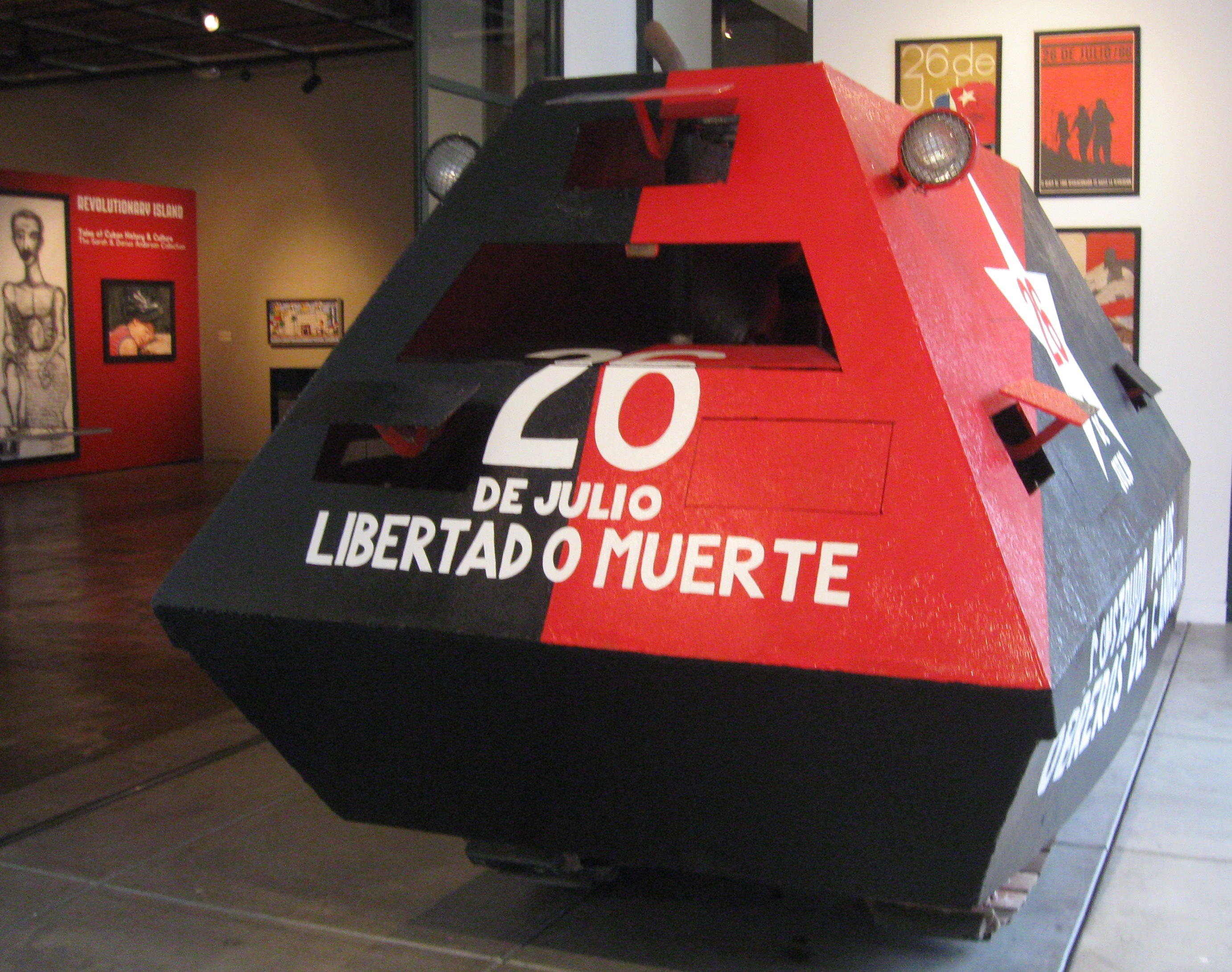
26 de Julio

26 de Julio

The exhibition includes a diverse array of historical objects, artifacts, and contemporary art in a range of media. The paintings, sculptures, prints, posters, photographs, and videos tell a story of Cuba’s culture and history from 1911 to the present. After entering through the lobby, decked out with Cuban baseball jerseys, the small side gallery displays early photographs of Fidel Castro and original pro-revolution posters. To intensify the revolutionary zeal, a black and red military tank, 26 de Julio, commands the central area of the room. The tank was inspired by the one driven into Havana by Fidel Castro and Ché Guevara to celebrate their victory. While most of the artwork in the exhibition is by Cuban artists, the tank was commissioned by Darius Anderson, and built in 2003 by Sonoma County artist, David Best, who is known for his distinctive art cars and involvement with the Burning Man project.

After viewing the ruckus of the revolution, another room, painted a tobacco brown, addresses Cuba’s cultural pastimes and interests, such as baseball, cigars, and rum. Photographs, artifacts, and ephemera portray, without judgment, the workers as well as the elite. Ornate humidors, elegant rum bottles, and sumptuous service ware represent commodities and diversions that had a historical impact on the country. They also reveal a noticeable contrast to the utopian communist ideologies of another era.

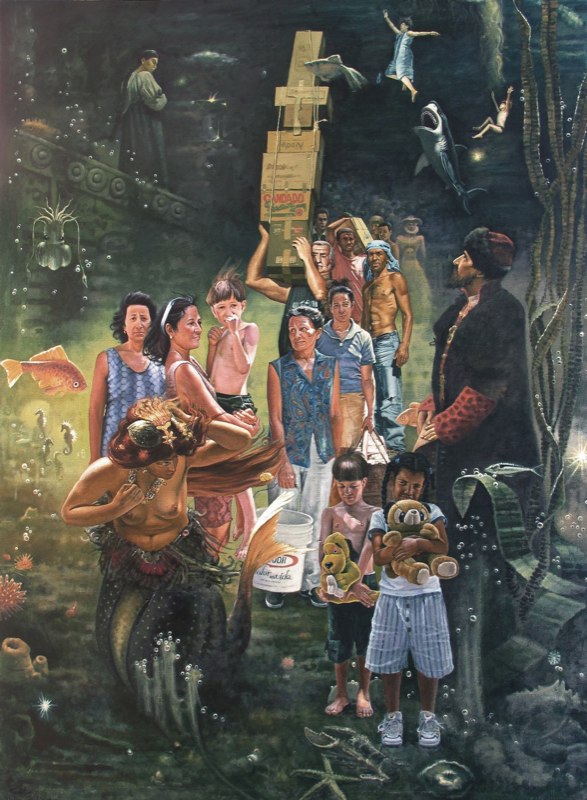
Underwater Kingdom

Underwater Kingdom

As the exhibition moves into contemporary times, the focus of much of the artwork expresses social and political narratives, and some of it is quite moving. Several paintings by Franklin Alvarez Fortun, from his Underwater Kingdom series, 2005-2006, take up one wall. The paintings reference a mythical underwater world, but the figures are portraits of Cuban’s who lost their lives in sinking vessels, trying to find a better place. Children hug their toys and people carry their belongings in buckets and boxes, as they continue their journey to a promised land beneath the sea.


Space Occupied by a Dream

Space Occupied by a Dream

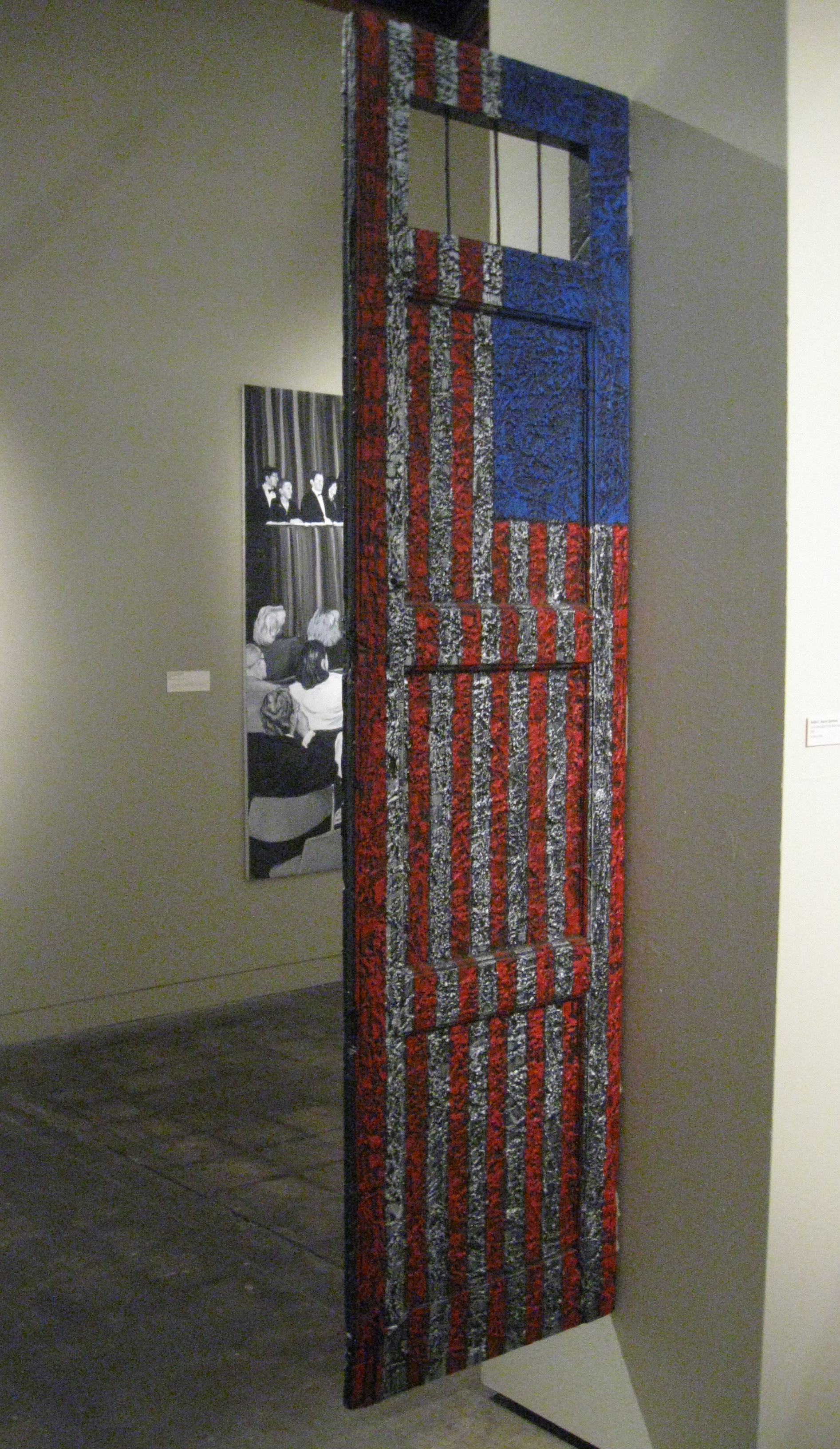
In Space Occupied by a Dream, 2000, a mixed media sculpture by Esterio Segura Mora, a figure of a man rests upon bundles of newspapers. Behind him, rows of old typewriters ascend the wall. Is he dreaming of fame, words to be written, or freedom of artistic expression? The meaning remains obscure. Perhaps a bit less ambiguous is an untitled piece by Mario Miguel Gonzalez Fernandez. From the edge of the gallery wall hangs one half of a swinging bar door—one side is painted with the Cuban flag, the other side with the American flag. No explanation was given, but it can be interpreted as a commentary on the complex and entangled U.S.–Cuban relations.

Untitled

Untitled

Though it is important to note that the work here is a reflection of the collector’s aesthetic and perspective, the exhibition gives broad insight into contemporary Cuban art. Early on, the Castro regime created state-sponsored art schools which were available to everyone. In the early years the schools promoted avant-garde aesthetics, and encouraged expression of culture, place and Cuban identity. The Instituto de Arte Superior was founded in 1976, and its students organized the first Havana biennial in 1984, which now includes work by international artists. These schools have endured even after the collapse of the Soviet Union and its economic support. In recent decades the sensibility of contemporary Cuban art has evolved, reflecting more outside influences from technology and increased tourism.

El Piano

El Piano

A piece towards the end of the exhibition, El Piano, 2006, by Rene Francisco Rodriguez, conveys the idea of the past informing the future. Set in a room of its own the painting shows a young girl sitting at the piano, hands on the keys, a spirit-like grandmother figure sits beside her, singing along. A video of traditional handwork is projected onto where the sheet music would be, while the sound of piano music plays in the background. The installation connects the past with the future, suggesting that national identity and Cuban heritage is still an important subject matter, and that art education continues to be a national value.

The exhibition continues through April 14, 2013. For additional information and related events, check their website, www.svma.org.

Photo credits:
Underwater Kingdom from svma.org.
All other photographs by the author.
Posted in Art Reviews | Tagged , , , | Leave a comment

Inez Storer @ Seager Gray Gallery, Part II

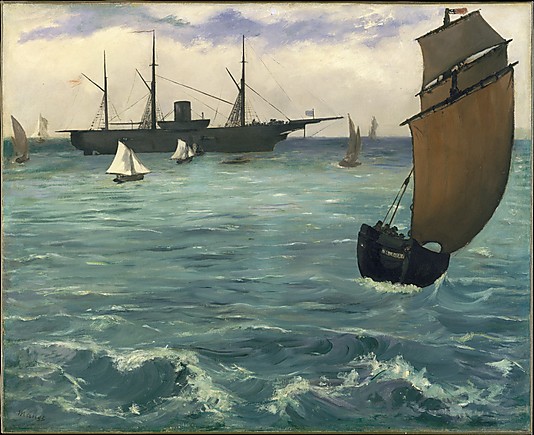
I originally posted this article on January 10, 2013, but recently I discovered a painting by Edouard Manet, called The ‘Kearsarge’ at Boulogne, 1864. I found it on the Metropolitan Museum of Art website. I don’t know if Inez ever saw this painting, but the similarities seem marvelous to me. By the way, the Inez Storer show is at Seager Gray Gallery until January 31, in case you have not seen it yet. The two images are at the bottom.

Storer

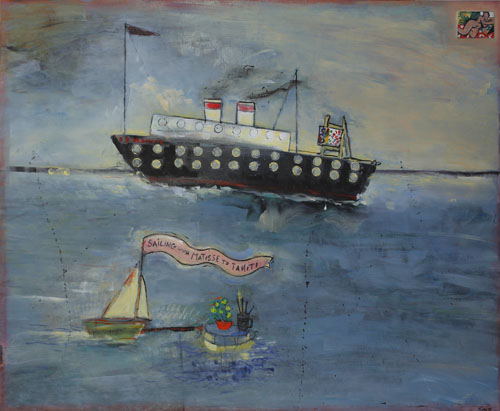
Sailing with Matisse to Tahiti, 2012, by Inez Storer.

Then at the Seager Gray Gallery in Mill Valley, the current exhibition is Inez Storer: Made up Stories from an Imagined Past. Inez is an accomplished and fascinating artist who lives near Point Reyes Station in West Marin. Her mixed-media work makes use of digital technologies along with traditional methods of painting, drawing, and collage. Using a story-board flatness of space, she combines illustrative renderings with bits of text. In this way she narrates her personal stories, blending them with popular imagery as well as imagined and real histories. The artwork suggests various aspects of her life, including objects in her daily surroundings, her connections to Russia, and a mixed cultural background that had been kept hidden from her as a child. The work occasionally makes art historical references to the likes of Matisse, Velasquez, and Rauschenberg. Each of the medium- to large-scale canvases or panels is like a page from a travel journal or postcard—layered with notes, stamps, and other markings collected during its journey through time. In Sailing with Matisse to Tahiti, from 2012, a steamship chugs jauntily through a blue-gray sea, with only a simple horizontal line distinguishing sea from sky. An oversized easel with a canvas is stationed on the back deck, suggesting that the Master may be on board. In the foreground a small green sail boat announces the title in its wind banner, as it sails toward a still life with vase of flowers and pot of brushes, curiously floating on the sea—perhaps some jetsam from the ship. A tiny image of a reclining nude is adhered to the upper right corner of the panel, like a postage stamp assuring delivery of the message. Overall, the collection of work reflects a life long-lived, well-travelled, and mulled over with wry amusement. A reception for the artist will take place on Friday, January 11 from 6 to 8 p.m. The exhibition will be on view through January 31. For more information check their website, www.seagergray.com.

The Kearsarge at Boulogne, 1864, by Edouard Manet.

The Kearsarge at Boulogne, 1864, by Edouard Manet.

Storer

Sailing with Matisse to Tahiti, 2012, by Inez Storer.

Inez Storer image from www.seagergray.com.
Edouard Manet image from www.metmuseum.org.
Posted in Art Reviews | Tagged , , , | Leave a comment

Terry Sauvé @ RiskPress Gallery; Inez Storer @ Seager Gray Gallery

CA Hills, Fields

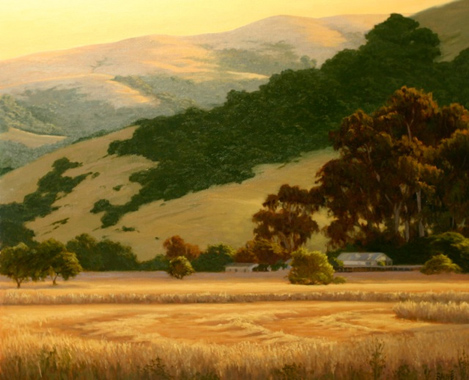
California Hills and Fields, by Terry Sauve.

The new exhibition at RiskPress Gallery in Sebastopol is Scenic Journey: Sonoma County and Beyond, paintings by Terry Sauvé. Terry begins her landscapes by painting en plein air, which is a French expression that means “painting out-of-doors”. Typically when an artist works in this way they must be quick and keen observers to capture the scene directly before them, as the light and other conditions can change rapidly. While Terry paints what she sees, she does not simply record the view. By also being attuned to the sounds, smells, and mood of the moment, she interprets the essence of the location with greater depth and insight. For example she may intensify a color, or adjust the composition of shapes and patterns to direct the viewer’s eye. Her soft-hued oil paintings are classic in their composition but contemporary in their uncluttered imagery. A good example of this is California Hills and Fields, where, in the foreground, arcs of freshly cut hay are gently bathed by the late afternoon sun, while the last rays glance off golden hills in the background. Sauvé uses the arcs of cut hay to direct our eyes to the homestead, now in the shadow of the hills. The colors and composition evoke a sense of peace and stillness at the end of a good day’s work. The exhibition continues through January 29. For more information check the gallery’s website, www.riskpress.com, or go to the artist’s website, www.terrysauve.com.

Storer

Sailing with Matisse to Tahiti, 2012, by Inez Storer.

Then at the Seager Gray Gallery in Mill Valley, the current exhibition is Inez Storer: Made up Stories from an Imagined Past. Inez is an accomplished and fascinating artist who lives near Point Reyes Station in West Marin. Her mixed-media work makes use of digital technologies along with traditional methods of painting, drawing, and collage. Using a story-board flatness of space, she combines illustrative renderings with bits of text. In this way she narrates her personal stories, blending them with popular imagery as well as imagined and real histories. The artwork suggests various aspects of her life, including objects in her daily surroundings, her connections to Russia, and a mixed cultural background that had been kept hidden from her as a child. The work occasionally makes art historical references to the likes of Matisse, Velasquez, and Rauschenberg. Each of the medium- to large-scale canvases or panels is like a page from a travel journal or postcard—layered with notes, stamps, and other markings collected during its journey through time. In Sailing with Matisse to Tahiti, from 2012, a steamship chugs jauntily through a blue-gray sea, with only a simple horizontal line distinguishing sea from sky. An oversized easel with a canvas is stationed on the back deck, suggesting that the Master may be on board. In the foreground a small green sail boat announces the title in its wind banner, as it sails toward a still life with vase of flowers and pot of brushes, curiously floating on the sea—perhaps some jetsam from the ship. A tiny image of a reclining nude is adhered to the upper right corner of the panel, like a postage stamp assuring delivery of the message. Overall, the collection of work reflects a life long-lived, well-travelled, and mulled over with wry amusement. A reception for the artist will take place on Friday, January 11 from 6 to 8 p.m. The exhibition will be on view through January 31. For more information check their website, www.seagergray.com.

Terry Sauve image from www.riskpress.com.
Inez Storer image from www.seagergray.com.


Posted in Art Reviews | Tagged , , , | Comments Off on Terry Sauvé @ RiskPress Gallery; Inez Storer @ Seager Gray Gallery

2012 in review

Thank you to all my readers for making 2012 a fun and satisfying year to write and share. Here is the annual report from W.P. of my most popular posts and other details.

The WordPress.com stats prepared a 2012 annual report for this blog.

Here’s an excerpt:

600 people reached the top of Mt. Everest in 2012. This blog got about 2,000 views in 2012. If every person who reached the top of Mt. Everest viewed this blog, it would have taken 3 years to get that many views.

Click here to see the complete report.

Posted in Uncategorized | Comments Off on 2012 in review

Larry Thomas & Handmade Paper @ Sonoma Valley Museum

Tree bark and leaves, seed pods and grasses can be a source of creative inspiration for artists as well as the components of papermaking. Being both delicate and tough, such fibrous elements are the focus of two inspiring exhibitions at the Sonoma Valley Museum of Art.

In the front part of the museum is Larry Thomas: Coastal Echoes. This exhibition of recent paintings, prints, drawings, and calligraphy comes from a body of work inspired by the Northern California coast. Thomas’ abstract imagery captures the changing moods of the coastal landscape, where water and land interact in a ceaseless shifting of patterns and rhythms. The exhibition consists of five different series that reflect on this coastal theme with poetic abstraction. After passing through a field of dangling paper prayer flags in the entryway, the gallery opens to a group of about ten large paintings called the Hawk Field Series from 2012. Muted pastel tones and curvilinear markings capture the feel of a wind-blown hill top. Like clouds in the sky, you can gaze at the paintings and see things, animals or birds, or something just on the edge

From "Hawk Field Series" by Larry Thomas.
From “Hawk Field Series” by Larry Thomas.

of familiar. In one I saw what could be a hare hiding in the grass, and thought of the fine etching of a hare by the fifteenth-century German artist, Albrecht Durer.

Another series is called Grass Mountain Drawings, from 2011 to 2012. The 14 drawings are displayed on a long low shelf along the wall. The ink and pencil drawings use calligraphic lines to describe what could be leaves and grasses, and perhaps skulls and feathers. The linear elements are softened and held together with an atmospheric wash of acrylic paint. Thomas worked primarily as a printmaker in the early years of his career before experimenting with other media, including calligraphy. Currently he is working on a series of larger-scale oil paintings. Larry Thomas was a professor of printmaking, and Dean of Academic Affairs, for many years at the San Francisco Art Institute before retiring to the Fort Bragg area in Northern California, where he currently lives and works.

Toward the back of the museum is a well-matched companion exhibition called The Art of Handmade Paper. This informative exhibition explores the connections between past and current papermaking traditions and practices of both eastern and western cultures. The curator, Simon Blattner, is a noted scholar and collector of handmade paper. Included are historic Japanese papers which date back several centuries, paper-making equipment, videos of the process, as well as examples of contemporary papermaking. One rare and remarkable piece is a 21-foot antique Japanese scroll that illustrates the stages of the traditional papermaking process, from the gathering of mulberry bark through the completion of the final product. This fine piece shares company with some excellent works by contemporary U.S. artists, such as Amanda Degener, Lynn Sures, John Babcock, Beck Whitehead, Helen Heibert, Michelle Wilson, Peter and Donna Thomas, and Susan Mackin Dolan. This recent work both honors the traditions, as well as pushes the boundaries of the medium by incorporating new materials and techniques. Executive Director, Kate Eilertsen, states, “The exhibition serves to remind that paper is not a simple utilitarian technology, but also an art form of the highest order.”

Japanese Papermaking Scroll, detail.

Japanese Papermaking Scroll, detail.

Both exhibitions continue through December 30. For more information check their website, www.svma.org.

Images from SVMA website.
Posted in Art Reviews | Tagged , , | 5 Comments

Sound, Image, Object: The Intersection of Art and Music @ SSU

The hills are filled with the sound of art, or . . . is it the sight of music? Actually it’s both, at least at the Sonoma State University Art Gallery, where currently on view is Sound, Image, Object: The Intersection of Art and Music. The exhibition features work by twenty contemporary artists from around the country whose art makes reference—either literally or conceptually—to music or sound, and includes sculptures, photographs, prints, video, and installations.

Music and the visual arts have a long history of mutual influence and cross-referencing. Composers, especially from the Romantic era, such as Tchaikovsky, endeavored to evoke visual images through their symphonies. In the visual arts of the Western world, the portrayal of music, singing and dancing goes way back. Images of angels playing stringed instruments appeared in early Renaissance paintings, and even before that, depictions of music and dance appeared in Egyptian art and Greek vase painting. But these were generally static images of figures with instruments. It wasn’t until the mid-nineteenth century that a French artist, Eugene Delacroix, painted a portrait of Paganini that was an attempt to express the sound or at least the passion of the music being played. Then later, in the early twentieth century Wassily Kandinsky strove to express the spirit of music through color, line, and abstract forms. In the mid-twentieth century, Abstract Expressionist action painters, such as Jackson Pollock, were known to listen to jazz music while they worked in their studios. Eventually, as the ability to record and reproduce sounds improved, artists began including actual music and sound in their work. Or, in the case of the avant-garde composer John Cage, whose 1952 composition, 4’ 33” (Four minutes, thirty-three seconds), only involved the ambient sounds of the concert hall, thereby making a firm reach into the realm of Conceptual Art.

J, Cage

Score without Parts, by John Cage

For artists today the possibilities of using sound are quite endless, especially through use of new media and the Internet. The work on view at the SSU Art Gallery reflects different ways music and art interact, and influence each other, literally or conceptually. While most of the work in the exhibition is by contemporary living artists, homage is paid to the late John Cage, who would have celebrated his centennial this year, with a piece called Score without Parts. The print was created by Cage in 1978 as part of a body of work he produced at Crown Point Press over a fifteen-year period.

Musical instruments play their part in the exhibition where there are both actual instruments as well as objects that make reference to them. For example the assemblage sculptures of William T. Wiley, Banjo for J.B., 1985, and Robert Hudson, E Flat, 1986, aren’t intended to be played, instead they evoke musical personalities and concepts. Whereas the sculptures of Terry Berlier are actual instruments and can

T. Berlier

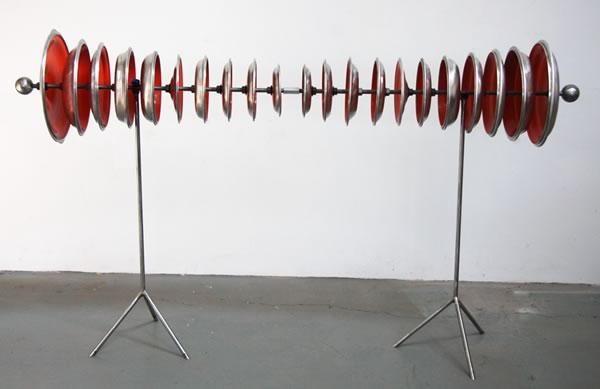
Pan Lid Gamelan II, by Terry Berlier.

be played by gallery visitors. These include Pan Lid Gamelan II, 2010, made of old pan lids arranged like a xylophone, and her Stairdrum, which is fashioned from wood, metal, and drum parts. Both have sticks available for creating your own inspired sounds in the gallery. Then, from a more conceptual stand point is Tom Marioni’s, Musical Instrument that Cannot be Played, 2003. Made of black lacquered wood, and looking like a miniature piano with no keys, it can only be pondered and not played. This static piece is accompanied by photographs of Marioni’s performative art, including historical events from the early 1970s, and his more recent, Drum Brush Drawing, which consists of marks made on sandpaper by a drum brush.

P. Kos

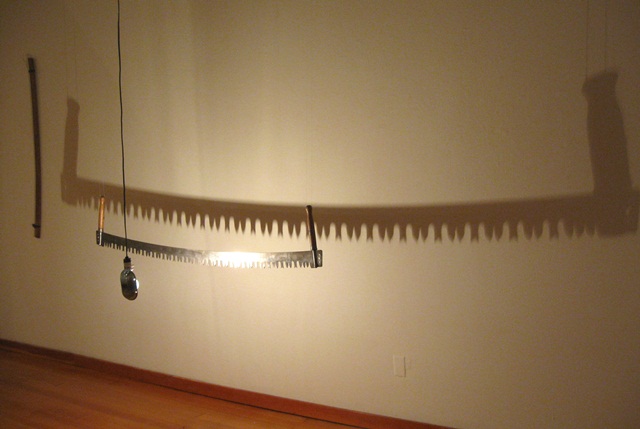
I Saw The Light, by Paul Kos

Musical compositions can also be expressed in visual formats. One example is the 2007 kinetic multimedia installation, I Saw The Light, by Paul Kos. This tongue-in-cheek, very literal, interpretation of the old Hank Williams’ tune by the same title includes an old timber saw, set in a pendulum sawing motion, illuminated by a hanging light bulb. The swinging saw and its shadow moving on the wall keep beat to an audio recording of the song, as they “saw the light”. The whimsical arrangement is very much in keeping with Paul Kos’ 1970 piece, The Sound of Ice Melting, which is comprised of a block of ice surrounded by a several standing microphones and speakers, and was recently seen at the Berkeley Art Museum.

I. Sorrell

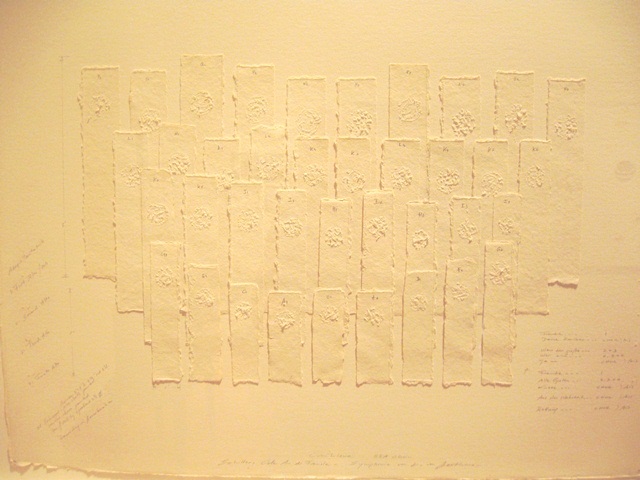
Cantilena, by Isabelle Sorrell.

In a different approach to visual interpretations of music, is Isabelle Sorrell’s, Cantilena, 1987. In this plain-framed piece, overlapping strips of white embossed paper, and penciled-in annotations, give it an appearance of simplicity. However, the piece is much more complex in its concept. Referencing, Beethoven’s IXth Symphony, Sorrell distilled the composition down to four alto voices, represented by four rows of paper strips. In the background the four alto voices, singing a capella, can be heard in the accompanying audio recording.

Other artists participating in the show are Mauricio Ancalmo, Brian Caraway, Chuck Close, Bruce Conner, Lewis deSoto, Chris Duncan, Jacqueline Kyomi Gordon, Victoria Haven, Christopher Janney, Jack Ox, Sarah Rara, Steve Reich, and Alice Wheeler. The exhibition continues through October 14. For more information, gallery hours, and parking updates, check their website, www.sonoma.edu/artgallery.

Photo of Pan Lid Gamelan II, from the artist’s website, all other photos by the author.
Posted in Art Reviews | Tagged , , , , , , , , , | Leave a comment

Adela Akers @ Quicksilver Mine Co.

Currently on view at Quicksilver Mine Co., in downtown Forestville, is Adela Akers, Threads of Illusion. The exhibition features large and small-scale hand-woven tapestries created over the past ten years, including work completed just this year. Adela’s beautifully crafted weavings are composed of abstract geometric patterns, inspired by pre-Columbian, African, and other textile-based cultures, as well as architecture and more contemporary abstract art modes. The repetitive geometric structures suggest language, coded messages, and forms of record keeping. For Adela, whose work is strongly influenced by her science background, the mathematical principles contrast well with the organic process of discovery, allowing for her inner visions to unfold.

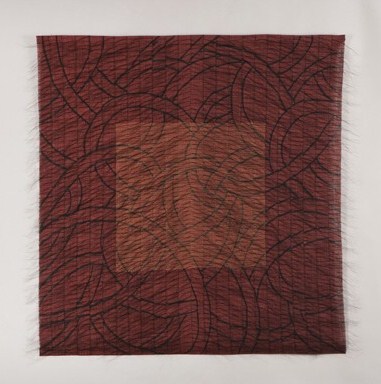
Circles in the Square, 2010

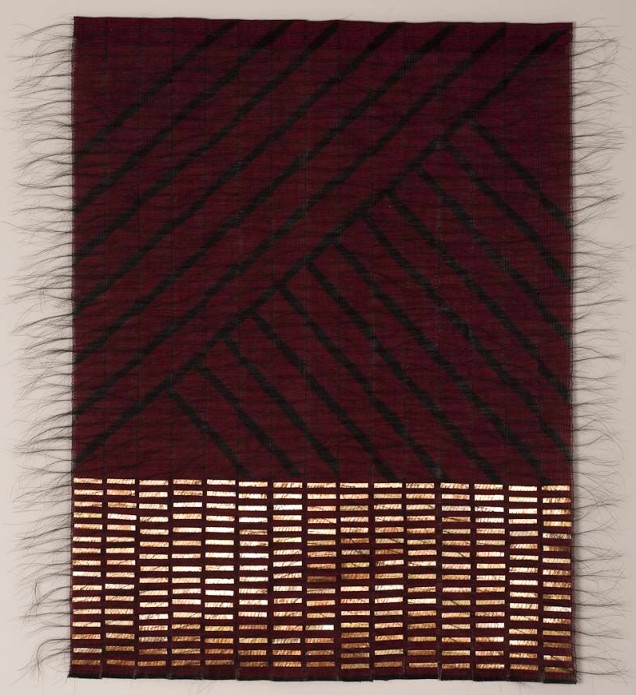
Akers considers herself an artist first, who happens to use fibers and weaving as her medium. This assertion is well supported by the complexity of her materials and process, which results in rich and detailed weavings. She begins with finely woven linen strips that are sewn together. Then additional materials are applied or incorporated. For example she weaves in horse hair, which historically has been used for upholstery fabric, but here adds elements of fine lines that soften the more hard-edge forms. She also applies paints and inks directly to the warp threads, or even to the finished woven cloth. Finally she adds thin bands of metal, which are recycled from the foil seals of wine bottles. These she cuts into narrow strips, then stitches onto the woven linen segments.

End Section, 2012

Adela currently lives and works in West Sonoma County, but her long distinguished career has taken many curves and turns. Born in Spain in the 1930s, and trained in science, she began her career as a biochemist in Cuba. She eventually moved to the United States, and studied at the Art Institute of Chicago, and the Cranbrook Academy of Art in Michigan. Later she taught textile arts at the university level on both coasts until her retirement. Akers has exhibited her work extensively, including solo shows in New York, San Francisco, Philadelphia, and Los Angeles. Her work can be found in the collections of the Smithsonian Institution, the Metropolitan Museum of Art, the Museum of Art and Design, as well as the Sonoma County Museum, and many private collections around the country.

You can also see a well-done video interview of Adela on the KQED Spark program. The video shows her working at her loom while she talks about her materials and process. The exhibition continues through September 23. For more information check the website, www.quicksilvermineco.com

Photos from Quicksilver Mine Co. website.
Posted in Art Reviews | Tagged , , | Leave a comment

Best Bets, 7.9.12

Here are my Best Bets in the visual arts for this week.

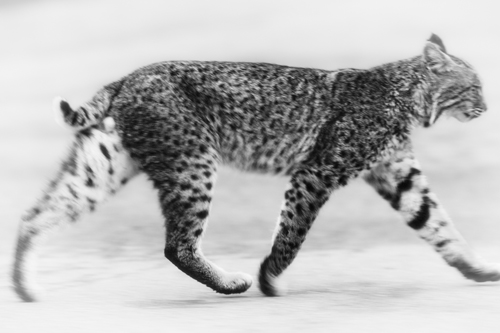
Bob Cat

“Bob Cat” by Trish Carney

Currently at di Rosa in Napa, is Entering the Wild, an exhibition that features over thirty pieces by six Northern California artists. Some years back Barry Lopez wrote an essay called The Near Woods, in which he described “the elusive and magical space between the wild, deep woods and the civilized space of humans”. This premise is the binding thread for the theme of this exhibition, and a special edition of the book, designed by Charles Hobson, is on view. Many of the other works in the show reflect on this margin between the animal and human world, bringing up questions such as; “How are we like them, and what can we learn from the mystery and wonder of their behavior?” In a large-scale wall installation called Up From Under the Edge, artist Adriane Colburn, uses various materials to investigate the complex relationship between human infrastructure and the natural world. She includes a viewing tube that’s set at about knee level, and if you make the effort to look in, you’ll see video footage of bugs and microbes that live beneath the soil.

In Animals Around Me, Lukas Felzmann uses photography to capture images of animals we may encounter, including wild, domestic, and dead ones, as well as those destined to be a food source. The piece as a whole is quite thought provoking. One of my favorite pieces, by Jane Rosen, White Scarf Skyscraper, is a hawk made of cast glass that is perched on a marble pedestal. To me it stands as a monument to the birds of prey that inhabit and nest in urban areas. The exhibition continues through September 23. For information check their website, www.dirosaart.org.

Then, at Sonoma Valley Museum, on Broadway, we have Cross Pollination; the Art of Lawrence Ferlinghetti. The title, Cross Pollination, is quite apt for this exhibition as it pulls together a number of influences and thematic parallels that have been consistent throughout his career. Most of us know Ferlinghetti as the beat era poet and co-founder of City Lights Bookstore in San Francisco, and both of these are true. However, Ferlinghetti, who is 93, has also devoted much of his career to the visual arts, and the show includes a very recent set of lithographs that he created to illustrate is latest poem book, Out of Chaos.

out of chaos

Out of Chaos

The paintings, prints, and drawings in the exhibition are a sampling of his work, which touch on the themes of politics, his relationship to women, and his time spent at sea. Through the work he also engages in direct dialogue with other artists and writers. The exhibition curator, Diane Roby, states that “In Ferlinghetti’s art, words give rise to image-making, and word and image meld in the paint.” A powerful painting, titled Moloch, sums it up. On the large canvas, iconic elements from The Scream, by Edvard Munch are painted in white on a black background, lines from Allen Ginsberg’s poem, Howl, are written across the top, and as the gallery label states, this is where “Howl meets the Scream”. The exhibition continues through September 23, for more information check their website, www.svma.org.

Posted in Art Reviews | Tagged , , , , , , , , | Leave a comment

Chester Arnold: Trees @ Sonoma County Museum

Through his paintings Chester Arnold brings us face to face with the harsh realities of “life in the country”; meaning we want the beauty of the forests, but we also want lumber for building, wood for burning. To help us ponder this dilemma Arnold also brings into his work an equal measure of hope and humor.

Having been tutored in Germany as a youth, Arnold has a keen awareness of traditional nineteenth-century European landscape painting. This influence can be noticed in the composition and development of the natural elements in his work, such as trees, sky, and seasonal conditions. Arnold was particularly influenced by the German romanticist, Caspar David Friedrich, whose pastoral landscape paintings are tributes to the spiritual mystery of nature’s vastness, where humans come and go, leaving their marks, but eventually nature prevails. Upon this backdrop Arnold overlays contemporary social-political issues such as environmental degradation, overconsumption and the mishandling of consumer waste. While many of Arnold’s paintings are based on natural landscapes and the impact of civilization upon it, the work in this particular exhibition focuses more specifically on trees and forests, bringing to our attention the very current issues of logging and land use, but we also see elements of natural decay, and the power of nature to keep things in balance.

Turning

“Turning”

In the 2009 painting, Turning, we see a copse of leafless trees in the foreground, marking the margin between nature and civilization. Brooding dark skies hover over an urban skyline in the background, forewarning the coming storm. A lovely, moody scene—if it weren’t for all the bits of litter and refuse strewn through the trees, clinging to bare branches. To the right of the forest is a cluster of city dwellings, set precariously askew, their windows appear as eyes staring with helpless concern, is their tidy domain being encroached upon? In the left corner a murmuration of starlings’ swirls in the sky, hinting at the presence of wildness, perhaps nature will prevail and take back its territory.

Crooked Timber

Crooked Timber

The allegory of man and nature appears in various ways throughout the work. In The Crooked Timber, 2010, the subject is a fallen tree; the twisted form of the once proud oak reclines on its side, the timber is crooked, not suitable as building material, but will make a good home for mice and beetles. The painting is accompanied by small sketches using washes of oak gall ink, lending a sense of lasting reverence to the great fallen tree.

Perpetual Care

Perpetual Care

Cemeteries offer compelling parallels to life, death, and rebirth in nature. Arnold’s painting Perpetual Care, shows tombstones of a neglected cemetery being consumed by nature for perpetuity of a different type. The scene takes place at the world’s edge, beyond is the great unknown, a small lone human tries to tend the memories, the crooked timber appears again, offering a perch to the raven who watches over knowing how the plot will unfold. In a similar manner the 1826 painting, Graveyard Under Snow, by Caspar David Friedrich, offers a similar message—humans are born, they die, nature takes over, all as it should be.

In a masterfully executed painting, Left Behind, 2010, we see a beautiful winter landscape, the edge of a forest along a snow-banked stream. Then, at closer look we notice the junk in the stream, detritus from human accumulation, which is slowly merging back into nature. In the distance, a man sits with his back to us at a campfire, deep in his own thoughts, which seem to drift away with the wafting smoke. Deftly painted brushstrokes intricately describe details of the twigs, pebbles, snow drifts, and smoke. The qualities of this wintery scene remind me of seventeenth-century Dutch paintings, such as Winter Landscape Near a Village, by Hendrick Avercamp, where the wintery village scene is populated with tiny figures going about their usual day-to-day routines, all in marvelous detail.

While living in Sonoma County, and teaching at College of Marin, Chester Arnold’s work has been shown and collected internationally and throughout the country. The paintings here present both a meditation and commentary on matters related to our precious native forests and woodlands.

Also at the museum is Hugh Livingston, Sonoma Oaks: Points of View. Livingston is a composer and multi-media artist, and for this exhibition he presents a series of audio and video installations on the patterns and sounds of California oak habitats. Livingston documents the environment with time-lapse and aerial photography, and he examines the sounds of raindrops and wind on oak leaves, then displays a “periodic table” of the sounds of Sonoma. This project is a continuation of his deconstruction of the Sonoma landscape, which began during his recent term in the Russian Riverkeeper Artist-in-Residence program. At that time Livingston recreated the essence of the Russian River as he had experienced it, and presented a multi-media color analysis of the Russian River. By dissecting and emphasizing selected elements, Livingston brings to our sensory awareness details we may otherwise have overlooked. Hugh Livingston’s work can also be found in the Museums outdoor sculpture garden.

A Curator’s tour of the exhibition is scheduled for Friday, July 6, 7 p.m. You can register on their website, space is limited.

The exhibitions continue through September 9, 2012. The Sonoma County Museum is located on Seventh Street in Santa Rosa. For more information check their website, www.sonomacountymuseum.org.

Images from www.sonomacountymuseum.org.


Posted in Art Reviews | Tagged , , , | 6 Comments

Best Bets 5.10.12

I am now recording audio spots for Best Bets on the Sonoma Arts website. You can go to their site and click the Best Bets button to hear the most recent posting, or you can read the text here on my website.

This week I recommend a visit to the Gatehouse Gallery at di Rosa, in Napa county. This time of year it’s a beautiful drive through vineyards, and green rolling hills. Once there you’ll see Cycle: New Work by Hung Liu, the current exhibition in the spacious lake-side gallery.

Hung Liu was born in China and immigrated to California in 1984, where she continued her studies in art. Liu’s work has been shown and collected by numerous top-notch museums in this country. She currently lives in the East Bay and teaches at Mills College.

The work in this exhibition features large, mixed-media paintings, which are derived from historical Chinese photographs. Starting with the photographic images, that are both her cultural and personal narratives, Liu reworks the surfaces with layers of various materials. In this process she conceals, changes, as well as reveals selected aspects of the original image. The story becomes a new narrative, combining both her future as well as her past.

The exhibition continues through June 10. While you are there, you may want to consider a tour of the sculpture gardens. The Gatehouse Gallery hours are Wednesday through Saturday, 10 a.m. to 4 p.m. For more information on events and tours, visit their website, dirosaart.org.

Then, at Art Works Downtown, in San Rafael, we have, Surface Design, an exhibition of nearly 30 pieces, that, according to the curator, Virginia Breier, illustrates the importance of surface design to the final object. And, indeed, when I saw the exhibition, I was impressed by how well the surface treatments were integrated with the artworks.

Plus there was a wide variety of materials and methods, including traditional ones such as wood, clay, glass, metal and fabric. But also more unusual materials such as coffee filters, tree bark, woven paper, and one I had never seen before, which was dried orange peels that were stitched together into large geometric shapes.

A reception for the artists is on Friday, May 11, 5 to 8 p.m. coinciding with San Rafael’s second Friday artwalk.The exhibition continues through June 22. For more information, check their website, Art Works Downtown.org.

Posted in Art Reviews | Tagged , , | 2 Comments